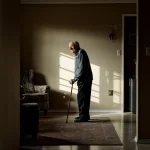
Yes, solar lights can be bright enough for seniors in 2025, but only if you choose the right ones.
The best outdoor solar lights for seniors provide at least 1200 lumens, a wide beam angle, and weatherproof durability, ensuring safety, visibility, and peace of mind at night.
Quick Rundown: How Good Are Solar-Powered Security Lights for Seniors
- Brightness Counts: Older adults need at least twice as much light, look for 1200–3000 lumens for safety, not just ambiance.
- Right Features Matter: Choose motion sensors (PIR or dual-tech), replaceable lithium-ion batteries, and IP65 weatherproofing.
- Senior-Friendly Setup: Split solar panels, wide beam angles, and tool-free mounting make installation safer and easier.
- Hybrid Options: In shady or low-sun areas, combine solar with wired lighting for reliable coverage.
- Long-Term Reliability: Check for warranties (12–24 months), battery replacement options, and clean panels every few months to maintain performance.
Now, let’s dive into why lighting needs increase with age and how to choose the safest solar setup for a senior’s home.
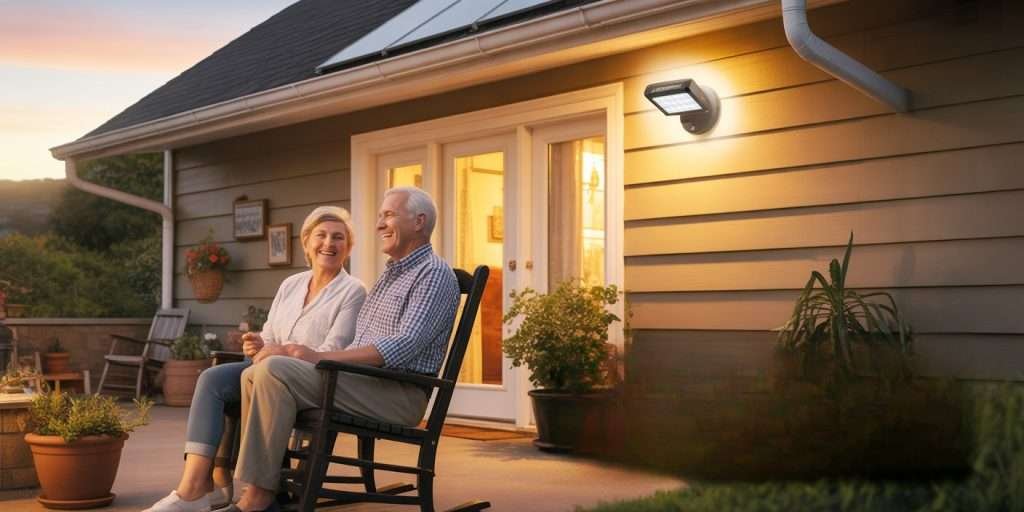
Why Brightness Matters More as We Age
As we get older, our eyes change. I noticed it myself when walking outside at night. Things looked blurrier, and shadows seemed darker.
My mom, who lived alone, once missed a step on her porch because her old light was too dim. That’s when we stepped in and improved the lighting throughout her outdoor area.
Older adults need more light to see safely.
According to lighting research from the Lighting Research Center at Rensselaer Polytechnic Institute, a 60-year-old requires roughly twice as much light as a 20-year-old to perform the same visual task, due to changes in the eye that reduce light transmission to the retina.
Dim paths or porches can lead to falls.
That’s why the lumen rating of your outdoor lighting is more than just a preference. It’s a safety issue.
❓What is a lumen rating?
💬 A lumen rating tells you how bright a light is. The higher the number, the brighter the light. For example, 300 lumens is soft and dim, while 1200 to 3000 lumens is strong enough for outdoor safety lighting. Lumens help you compare brightness when shopping for lights.
❓What is the best color temperature for outdoor solar security lights?
💬 A color temperature of 5000K (daylight white) is ideal for outdoor security. It creates a bright, clear light that improves visibility without being too harsh. Lower color temps like 2700K are more for mood lighting, not safety.
Are Solar Lights Really Bright Enough in 2025?
Yes, but only the high-output models. In 2025, newer solar-powered LED floodlights can reach 1200 to 3000 lumens, which is ideal for senior safety.
The key is to check the specifications.
What to look for:
- Minimum 1200 lumens for pathways and entryways
- 1600-3000 lumens for driveways, garages, or backyards
- Instant-on LED lighting for safe navigation
Here’s a helpful lumen-by-location chart:
- Pathways and steps: 300–700 lumens
- Porches and patios: 700–1200 lumens
- Driveways and backyards: 1200–3000 lumens
Avoid solar lights under 1000 lumens unless you’re only using them for decorative purposes. A motion-activated spotlight with a wide-angle beam will offer better visibility and safety.
❓Can solar-powered lights be left out all year, even in snow or high heat?
💬 Yes, but it’s important to choose lights with a weatherproof rating of IP65 or higher. These models are designed to handle rain, snow, and heat. Just make sure the battery is rated for temperature fluctuations, especially if you live in an area with freezing winters or intense summers.
How to Choose the Right Solar Security Light for a Senior’s Home
If you or a loved one is aging in place, here’s what to look for:
- Adjustable motion detection: Choose lights with motion-sensor range between 15 to 40 feet, and customizable sensitivity to reduce false alarms.
- Longer light duration: Ensure the light stays on for at least 30 to 90 seconds after motion is detected.
- Split solar panel design: A separate monocrystalline panel can be placed in direct sunlight even if the light fixture is mounted in a shady spot.
- Rechargeable lithium-ion batteries: Look for battery capacity rated 2000 mAh or more, and choose models with replaceable battery packs.
- Wide beam angle: Lights with a 120° to 270° coverage help avoid harsh hotspots and improve even lighting.
- Tool-free mounting: Many senior-friendly models include quick-connect brackets or clamp mounts to avoid using ladders.
❓Do all solar lights have replaceable batteries?
💬 Not all of them. Many budget models have sealed battery compartments, which makes replacement difficult or impossible. Look for brands that clearly state “replaceable lithium-ion battery” in their specs, so you can maintain brightness over time.
Understanding Motion Sensor Technology
Motion sensors trigger your light when movement is detected. But not all motion sensors are equal. Here’s a breakdown:
- Passive Infrared (PIR): Most common, senses heat from people or animals. Reliable and energy-efficient.
- Microwave Sensors: Use radar waves to detect motion. Works through glass and thin materials, but may be sensitive to wind.
- Dual-Tech Sensors: Combine PIR and microwave technology to reduce false triggers. Ideal for yards with trees or heavy foot traffic.
If wind or pets cause false alarms, go for dual-tech detection with an adjustable sensor head.
Don’t Get Left in the Dark: Battery & Weather Performance Tips
Living in South Florida, I learned fast that not all solar lights are built for extreme heat.
One summer, our low-cost light stopped working after just two weeks of 100-degree days. That’s when I started paying attention to specs.
What to look for:
- IP65 or IP67 rating: These indicate water and dust resistance, great for rain, snow, and dust storms.
- Battery runtime: You want at least 8 to 10 hours of light per full charge.
- Charge time: Look for solar panels that fully charge in 6 to 8 hours of daylight.
- Maintenance tips: Clean solar panels every 2–3 months to prevent dirt from reducing performance.
- Warranty coverage: A good solar light should come with at least a 12-month warranty. Premium models offer 18–24 months.
❓Are there solar lights that work without direct sun exposure?
💬 Some models with larger monocrystalline solar panels or detachable panels can charge in partial sunlight, but they still need several hours of indirect light to work. For heavily shaded areas, consider battery backup systems or hybrid solar/wired combos.
Compare Top-Rated Solar Lights for Seniors
Here are a few models that perform well for brightness, durability, and smart features:
| Brand & Model | Lumens | Sensor Range | Runtime | Smart Features | Warranty |
|---|---|---|---|---|---|
| Tuffenough 3000lm | 2500–3000 | 26–33 feet | 8–10 hours | Remote control, 3 lighting modes | 18 months |
| LEPOWER 1600lm | 1600 | 30 feet | 8 hours | Adjustable dual-heads, 270° wide coverage | 1 year |
| HETP Solar Motion Light | 1000–1500 | 20–26 feet | 6–10 hours | Compact design, split panel, wide angle | 12–18 months |
| HMcity 120 LED Light | 420 | 20 feet | 6–8 hours | Budget option, 120° coverage, PIR sensor | 1 year |
When Solar Isn’t Enough: Combine for Maximum Safety
Solar lights work well in most places, but they aren’t perfect. If you have lots of shade, poor winter sunlight, or north-facing walls, try combining solar with:
- A wired dusk-to-dawn floodlight for consistent coverage
- Solar-powered path lights with reflective tape or edging
- Plug-in motion sensor lights near entryways or garages
This hybrid setup helped my aunt who lives under tall trees. Her lights work well now even on cloudy days.
How to Install Solar Security Lights (Even Without a Ladder)
Most solar light kits are designed for easy DIY installation. Look for:
- Quick-mount brackets that attach to fences, poles, or railings
- Adjustable tilt panels to face the sun (south-facing is best in the U.S.)
- Installation height of 6 to 8 feet for ideal motion detection
Many lights include adhesive pads or clamps so you don’t have to drill holes or climb ladders.
❓How do I test solar lights before installing them permanently?
💬 Let them charge in sunlight for 6–8 hours, then cover the panel completely to simulate nighttime. Wave your hand or walk by the sensor to check if the light turns on. Adjust the angle before final installation.
Real Feedback from Seniors & Caregivers
I’ve read stories on Reddit and seen reviews on YouTube where caregivers shared the same concern I had, lights that shut off too quickly.
One woman said her mom slipped because the light only stayed on for 15 seconds.
Another reviewer praised the LEPOWER model because it kept their yard bright for the whole night.
Caregivers like the Tuffenough lights for the remote control and HETP lights for how simple they are to mount without tools.
Light Pollution and Nighttime Balance
Too much light at night isn’t always better. Bright fixtures that stay on all night can affect sleep, attract bugs, or annoy neighbors.
Use motion-activated lights with adjustable brightness or dim + motion bright mode. Keep lights pointed down and away from windows.
The Bottom Line: Yes, But Only If You Choose Wisely
Solar-powered outdoor lights can absolutely keep seniors safe, but you need to choose wisely.
Look for:
- Minimum 1200 lumens for visibility
- Wide beam angle of at least 120°
- Dual-tech or PIR sensors with adjustable range
- Replaceable lithium-ion batteries, 2000 mAh or more
- IP65 or better weather protection
- Monocrystalline solar panel for fast charging
If you or someone you care for wants to feel safer at night, solar-powered security lighting is a smart, low-maintenance solution. Just make sure it’s bright enough to help, not just decorate.