Poor lighting may not seem dangerous at first glance, but for older adults it can be a hidden hazard. The truth is, better lighting can prevent falls in seniors by reducing shadows, improving visibility, and making it easier to move safely through the home.
Caregivers often worry about nighttime trips to the bathroom or dim hallways that increase fall risks. It’s comforting to know that simple upgrades, like brighter bulbs, motion sensors, and task lighting, can make a dramatic difference in keeping seniors safe.
Quick Rundown: How Better Lighting Prevents Falls in Seniors
- Reduces Hazards: Dim lighting is a primary cause of falls, especially at night.
- Improves Visibility: Bright, even illumination minimizes shadows and enhances depth perception.
- Hands-Free Safety: Motion-sensor lights offer automatic illumination in critical areas like hallways and bathrooms.
- Prevents Accidents: Task lighting in kitchens and reading zones specifically prevents eye strain and reduces accident risk.
- Safe Navigation: Outdoor lighting is crucial for secure entry and exit from the home after dark.
With these essentials in mind, let’s explore how better lighting creates a safer, more supportive home environment for seniors.

Understanding Age-Related Vision Changes
As we get older, our eyes go through several changes that can make it harder to see, especially in low-light conditions. One of the most common changes is that the lens inside the eye becomes less flexible, making it more difficult to focus on close objects.
Additionally, the pupils get smaller and respond more slowly to changes in lighting, which can cause seniors to have trouble adjusting when moving from bright areas to dim ones, such as entering a dark hallway from a well-lit room.
Effects of Aging on Vision and Light Perception
This decline in vision means older adults are more prone to accidents, particularly falls, which can happen if they can’t see clearly enough to avoid obstacles.
Reduced contrast sensitivity (difficulty seeing differences between colors or shades) can also increase the risk of tripping. For example, a senior might not notice a step if it blends in with the surrounding flooring.
Another example is an older adult may try to step over what appears to be a hole in the ground but is actually a shadow.
With age, the eyes’ ability to adapt to changing light conditions diminishes. This means seniors may have trouble seeing clearly when moving between bright and dim areas.
The pupils also become smaller and less responsive, reducing the amount of light entering the eye.
Other common age-related vision changes include:
- Decreased contrast sensitivity, making it harder to distinguish objects from their background (so never use a white plate on a white tablecloth).
- Increased sensitivity to glare.
- Reduced depth perception.
- Difficulty focusing on close-up tasks.
These changes can significantly impact a senior’s ability to navigate their home safely, especially in areas with poor lighting.
Lighting and Medication Interactions
When caring for an elderly loved one, it’s important to be aware that certain medications can affect their sensitivity to light and increase their risk of falling. Some medications, especially those used to treat high blood pressure, depression, or allergies, can make seniors more sensitive to bright light or cause vision changes.
For example, medications like diuretics or antihistamines may lead to dizziness or blurred vision, which could make navigating dimly lit areas more challenging.
Being mindful of this and adjusting the home’s lighting to provide even, adequate illumination in areas where falls are more likely, such as stairways, bathrooms, and hallways, can help reduce the risk of accidents.
You should also talk to their healthcare provider about any potential side effects of their medications related to light sensitivity or vision.
For more on how medications might impact fall risk, you can visit this study on medication-induced fall risk in older adults.
Increased Lighting Needs for Seniors
Research shows that by the age of 60, people need about three times as much light to see well as they did when they were in their twenties.
This means that relying on standard lighting might not be enough to ensure their safety.
These vision-related challenges, combined with other factors, contribute to the increased fall risk in seniors. For a comprehensive approach to fall prevention, consider reviewing our home fall prevention guide.
Assessing Current Lighting Conditions
As an occupational therapist specializing in aging in place, I can’t stress enough how crucial it is to evaluate the existing lighting in your loved one’s home.
Proper lighting is a key factor in preventing falls and maintaining independence for seniors.
Evaluating Existing Home Lighting
Before making any changes to the lighting in a home, it’s important to evaluate the current conditions.
- Start by walking through each room and paying attention to the overall brightness. Is there enough light in commonly used spaces like the kitchen, living room, and bathroom?
- Look for areas where shadows are cast – these are potential tripping hazards that could increase the risk of a fall.
- Poor lighting in hallways and stairways, in particular, can make it difficult for older adults to see where they’re stepping, leading to accidents.
- Next, consider whether the light fixtures are easy for a senior to access and control.
- Are light switches located in convenient places, or are they hard to reach?
- Are the bulbs energy-efficient and bright enough, or do they need to be replaced with something stronger?
While assessing lighting conditions, it’s also important to consider other fall hazards in the home.
Our fall prevention checklist can help you identify and address potential risks throughout the living space.
Here are some more key points to consider:
- Brightness levels: Are all areas of the home adequately lit? Remember, seniors need up to three times more light than younger adults to see clearly[4].
- Consistency: Is the lighting even throughout each room, or are there dark spots and shadows?
- Glare: Look for shiny surfaces that might cause uncomfortable glare, which can be particularly troublesome for seniors with cataracts[8].
- Light switches: Are they easy to locate and operate, even in the dark?
- Natural light: How well is natural light utilized during the day?
Using Light Meter Apps for Home Assessment
Based on the search results, there are a few light meter apps that could potentially be used to measure light levels, though they don’t all specifically mention measuring lumens.
Here’s some relevant information:
- My Light Meter Pro is described as an easy-to-use and reliable light meter application[1]. While lumens aren’t specifically mentioned, it’s designed for photographers and focuses on measuring light levels.
- Lux Light Meter Pro is available on both Android and iOS platforms[3][4]. This app measures light intensity in lux and foot-candles. While lumens aren’t directly mentioned, lux is a measure of illuminance (lumens per square meter), so this app could be useful for estimating the amount of light in an area.
It’s important to note that while these apps can be useful for general light measurement, their accuracy may vary compared to professional equipment.
Additionally, most of these apps seem to focus on lux or exposure values rather than directly measuring lumens. To get an accurate lumen measurement, you might need to convert from lux to lumens, which requires knowing the area being illuminated.
For the most accurate results, especially if you need precise lumen measurements, it may be best to use a dedicated, calibrated photometer rather than a smartphone app.
Common Lighting Problems in Older Homes
Many older homes weren’t designed with the lighting needs of seniors in mind. After all, the concept of aging in place was not something society was thinking about 50 years ago.
Here are some common issues you might encounter:
- Insufficient overall lighting: This is often the most obvious problem. Rooms that felt cozy years ago may now be too dim for safety.
- Poor task lighting: Areas where your loved one reads, prepares food, or engages in hobbies may lack focused lighting.
- Harsh shadows: These can create the illusion of obstacles and increase fall risk.
- Exposed bulbs: These can cause discomfort and temporary vision impairment when looked at directly.
- Lack of nighttime lighting: Inadequate lighting for nighttime trips to the bathroom can be particularly dangerous.
- Hard-to-reach fixtures: Lamps or overhead lights that are difficult to access can lead to unsafe situations when changing bulbs.
By identifying these issues, you’re taking the first step towards creating a safer, more comfortable environment for your senior loved one.
What Type of Lighting is Most Effective For Older People?
As I mentioned earlier, when people get older, their eyes change. The lens inside the eye often becomes more yellow. This makes it harder to see cooler colors clearly.
To help with this, it’s good to use lights that give off a “cooler” kind of light. These lights usually look whiter or slightly bluish.
They’re not actually cold – it’s just how the light looks.
Good choices are light-colored halogen bulbs or fluorescent bulbs. Look for ones that say they’re in the “cool” range, usually between 2900 and 3500K.
The “K” stands for Kelvin, which is how we measure light color. These cooler lights often seem brighter to older eyes. They can help older people see better by making up for the changes in their eyes.
Specific Lighting Solutions for Senior Safety
When it comes to safety lighting for seniors, it’s important to think about how different types of lighting can improve visibility and reduce the risk of falls.
Here are some key lighting solutions:
Types of Lighting Fixtures
When it comes to safety lighting for the elderly, we need to consider three main types of lighting:
- Task lighting: This is focused lighting that helps seniors perform specific activities safely. For example, a bright desk lamp for reading or under-cabinet lights in the kitchen for food preparation.
- Ambient lighting: This provides overall illumination for a room. Think ceiling fixtures or wall sconces that create a well-lit environment without harsh shadows.
- Accent lighting: While primarily decorative, strategically placed accent lights can highlight potential hazards or provide gentle nighttime illumination.
Recommended Light Levels for Different Areas
Different areas of the home require different levels of lighting. Here’s a quick guide for lighting solutions for older adults:
- Living areas: In living rooms or common areas, aim for bright but diffused lighting. Ceiling fixtures or large lamps with soft, LED bulbs can help create an even light that reduces shadows and glare.
- Bedrooms: Nightlights are crucial in bedrooms, especially near the bed or along the floor to guide seniors during nighttime bathroom trips. Choose motion-sensor nightlights that turn on automatically, so seniors don’t have to fumble for switches in the dark.
- Bathrooms: Bathrooms need bright task lighting, especially around the sink and mirror. Consider installing a nightlight that stays on overnight, or a motion-sensor light that activates when someone enters. Since bathrooms often have slick surfaces, good lighting here is essential for preventing slips and falls.
- Kitchens: In kitchens, bright task lighting over counters and cooking areas is necessary. Under-cabinet lights can provide focused light where seniors are preparing meals, ensuring they can see clearly while using knives and cooking utensils.
- Staircases and hallways: These are high-risk areas for falls, so bright, continuous lighting is key. Place lights at the top and bottom of stairs, and along hallways. Adding handrails with integrated lighting is another way to improve safety.
Reducing Glare and Shadows
One common issue with lighting for seniors is glare, which can make it harder to see clearly. Glare occurs when light reflects off shiny surfaces, causing discomfort or temporary blindness.
To reduce glare, use matte finishes on bulbs and avoid highly polished surfaces near light sources. Diffused or frosted bulbs can also help soften the light, making it more comfortable on the eyes.
I personally use soft lighting in my bedroom to help reduce glare when I’m reading in bed. Plus, a softer light seems to be helping to improve my sleep.
Shadows are another concern, especially in areas where seniors are walking. To minimize shadows, use multiple light sources in a room rather than relying on a single overhead light.
This helps distribute light more evenly and reduces the likelihood of dark areas where someone might trip.
Smart Lighting Technology for Seniors
As technology becomes more advanced, it’s now easier than ever to incorporate smart lighting solutions into a senior’s home to improve safety.
Smart lighting can help prevent falls and make life easier for older adults by offering more control over the lighting in their homes.
Here are some great options:
Motion-activated lights
Motion-activated lights are a simple yet effective way to make sure seniors can safely move around their home without needing to fumble for a light switch.
These lights automatically turn on when they detect movement, which can be especially helpful in dark hallways, bathrooms, and staircases – these are all places where falls are most likely to happen.
Many of these lights can be installed as battery-operated options, making them an affordable and easy DIY project.
For example, if a senior gets up during the night to use the bathroom, motion-activated lights can provide instant illumination without the need to navigate in the dark. This reduces the risk of tripping over obstacles or missing steps in the dark.
Voice-controlled lighting systems
Voice-controlled lighting systems, like smart speakers connected to lights, offer seniors even more convenience.
For individuals with mobility issues, arthritis, or vision impairments, adjusting lights using voice commands can be a game-changer.
Instead of struggling with light switches, a senior can simply say, “Turn on the living room light” or “Dim the bedroom lights” to control their home’s lighting.
Systems like Amazon Alexa or Google Home can be connected to smart light bulbs, making it easy to manage lighting from anywhere in the house.
This can also provide peace of mind for caregivers, knowing their loved one won’t have to struggle with difficult-to-reach light switches.
Automated lighting schedules
Another helpful smart lighting feature for seniors is automated lighting schedules. With this option, lights can be set to turn on or off at specific times of the day.
For instance, you could program lights to turn on in the morning as your loved one wakes up or dim in the evening as bedtime approaches. This is especially useful for seniors who may forget to turn lights on or off, reducing the risk of navigating a dark home or wasting energy.
Automated schedules also help keep a consistent routine, which is particularly beneficial for seniors with memory issues or dementia.
Having lights automatically come on at the right time of day can create a sense of comfort and familiarity.
Implementation Tips
Now that we understand the importance of proper lighting for elderly safety, let’s discuss some practical ways to implement these changes in your loved one’s home.
DIY Lighting Solutions for Elderly Homes
There are several simple lighting changes you can make yourself to enhance safety without the need for professional help.
Here are a few ideas:
- Install Nightlights: Placing nightlights in hallways, bedrooms, and bathrooms can help seniors navigate their home safely at night. Look for motion-sensor nightlights that turn on automatically as soon as they detect movement. These are easy to install and don’t require complicated wiring.
- Switch to LED Bulbs: If the home still has old incandescent or dim bulbs, consider replacing them with energy-efficient LED bulbs. LEDs provide brighter, more consistent light, which is essential for older adults who may have trouble seeing in dim conditions. They also last longer, reducing the need for frequent bulb changes.
- Add Floor and Table Lamps: If certain areas of the home are too dim, adding floor lamps or table lamps can brighten up the space without much effort. These lamps are especially helpful in living rooms and reading areas, where seniors may spend a lot of time.
- Use Stick-on Lights: Battery-powered stick-on lights are a great option for dark closets, cabinets, and staircases. They’re easy to install, affordable, and can instantly improve visibility in small, tricky areas.
- LED Light Strips: Place LED light strips under furniture, such as a couch or bed, to create a soft, ambient glow. This can help illuminate pathways and reduce tripping hazards.
- Install Lighted Switches: These days it’s easy enough to switch out a plain old light switches with ones that light up!
- Solar-Powered Lights: Install solar-powered lights in outdoor areas, such as patios or walkways, to provide a safe and secure path.
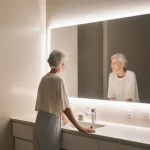
- Lighting Mirrors: Place mirrors with built-in LED lights in areas where natural light is limited, such as bathrooms or hallways. This can help reflect light and create the illusion of more space.
- Under-Cabinet Lighting: Install LED lights under kitchen cabinets or bathroom vanities to provide task lighting and reduce shadows.
- Lighting Canopy: Install a canopy with LED lights above the bed or seating area. This provides a warm and cozy glow, reducing shadows and improving visibility.
- “Glow-in-the-Dark” Staircase: Apply glow-in-the-dark paint to the edges of each step, making them visible in low light. Add extra flair with glow-in-the-dark tape on handrails for added safety.
Just as a side note, I do want to also mention that in addition to lighting improvements, consider other home modifications to enhance safety.
For instance, fall-resistant flooring options can provide an extra layer of protection against injuries from potential falls.
Remember, even small changes can make a big difference in your loved one’s safety and comfort.
Professional Consultation and Installation
While DIY solutions are great, some lighting improvements require professional installation of safety lighting:
- Consult with an electrician or lighting specialist to assess your loved one’s home. They can identify areas that need improvement and suggest appropriate solutions.
- Consider installing dimmer switches or smart lighting systems. These allow for easy adjustment of light levels throughout the day.
- For major renovations, like adding recessed lighting or rewiring, always hire a licensed electrician. This ensures the work is done safely and up to code.
- Don’t forget about outdoor lighting. A professional can install motion-activated floodlights or pathway lighting to improve safety outside the home.
Cost Considerations and Financial Assistance Options
Improving home lighting doesn’t have to break the bank.
Here are some cost-effective strategies and potential financial assistance options:
- Start with low-cost solutions like changing bulbs or adding plug-in lights. These can make a significant difference without a large investment.
- Look for energy-efficient lighting options. While they may cost more upfront, they can save money on electricity bills in the long run.
- Check if your loved one qualifies for home modification grants. Some local and state programs offer financial assistance for home safety improvements, including lighting upgrades.
- Consider the Weatherization Assistance Program (WAP). This federal program helps low-income households improve energy efficiency, which can include lighting upgrades.
- If your loved one is a veteran, they may be eligible for the Home Improvements and Structural Alterations (HISA) grant from the VA, which can cover some lighting modifications.
While there may be some upfront costs, the long-term benefits of preventing falls and improving quality of life are invaluable.
Additional Benefits of Improved Lighting
Impact on Mood
Good lighting does more than just help seniors see better, it can also enhance their mood and support cognitive function.
Studies show that bright, natural light can improve alertness and reduce symptoms of depression, especially in older adults. By enhancing visibility for seniors through proper lighting, we can significantly impact their quality of life.
Many seniors, especially those with limited mobility, spend most of their time indoors, where poor lighting can contribute to feelings of isolation and sadness.
Natural light, or lighting that mimics daylight, can help regulate mood by boosting serotonin levels, which is often referred to as the “feel-good” hormone.
This is especially important for seniors who may struggle with depression or cognitive decline.
By increasing exposure to bright, even lighting during the day, caregivers can help their loved ones stay more mentally and emotionally engaged.
Impact of Lighting on Cognitive Function in Seniors
Mood is not the only additional benefit of good lighting. It can also play a role in cognitive function, especially for seniors with dementia or Alzheimer’s.
Research suggests that proper lighting can help improve focus, reduce confusion, and support overall cognitive abilities in older adults.
Research has shown that ambient bright light therapy can have positive effects on behavioral and psychological symptoms of dementia (BPSD).
The most effective ambient bright light interventions targeted approximately 350-750 lux, 4,500-9,325 K, and/or circadian stimulus of 0.375-0.4 for 10-12 hours a day for 4 weeks or longer.
For individuals with dementia, well-lit environments can reduce feelings of disorientation and anxiety, especially during the evening hours when confusion tends to worsen, a phenomenon known as “sundowning.”
Biodynamic lighting, also known as dynamic lighting, is a promising non-pharmacological intervention for managing sundowning symptoms in dementia patients. This type of lighting mimics natural daylight patterns, adjusting light intensity and color temperature throughout the day.
Inadequate lighting can make it harder for seniors to recognize objects or people, which can increase frustration and confusion.
By using bright, evenly distributed lighting during the day, you can help your loved one stay alert and engaged. In the evening, switching to softer, warmer lighting can provide a sense of calm and help reduce cognitive over-stimulation.
This can be particularly helpful for seniors who are experiencing memory problems or difficulty processing their surroundings.
For more insights on how lighting affects cognitive function in seniors with dementia, you can read about the impact of lighting on dementia care environments.
Potential Improvements in Sleep Quality
Circadian Lighting for Seniors: Supporting Healthy Sleep Patterns
Another major benefit of improved lighting is its effect on sleep patterns. As people age, they often experience changes in their sleep cycle, which can lead to poor-quality rest or insomnia.
Circadian lighting is designed to mimic the natural changes in sunlight throughout the day, which can help regulate the body’s internal clock.
For seniors, especially those with cognitive decline or dementia, circadian rhythms can become disrupted. This can lead to issues with sleep, mood, and overall well-being.
By using lighting that changes in intensity and color temperature throughout the day—bright and cool in the morning, and warm and dim in the evening, you can help support your loved one’s sleep-wake cycle.
In the morning, exposure to bright, cool-toned light can promote alertness and improve mood.
As the day progresses, shifting to softer, warmer tones in the evening can help signal that it’s time to wind down.
Studies have shown that circadian lighting can improve sleep quality and even reduce symptoms of depression in older adults .
If you’re considering making lighting adjustments in the home, be sure to look for circadian lighting systems, or simply use smart bulbs that allow you to change the light settings throughout the day.
Making these changes could contribute to better sleep and overall quality of life for your loved one.
So there you have it! By implementing these lighting strategies and recommendations for aging in place, you’re not just reducing fall risks – you’re potentially improving your loved one’s overall quality of life and creating a safer living environment for the elderly.
Remember, every senior’s needs are unique, so it’s always a good idea to consult with a healthcare professional or lighting specialist to create a personalized lighting plan.