Christmas is a special time of year for older adults and their families. It can also be one of the hardest, especially when someone you love is living with dementia or Alzheimer’s disease.
I spent years working with older adults as an occupational therapist, and I can tell you the holidays stir up a lot of feelings.
The noise, the crowds, the changes in routine and the pressure to make everything perfect can leave a person with memory loss feeling confused and overwhelmed. And honestly, it can leave their caregivers feeling the same way.
The good news is that a little planning goes a long way. Whether you celebrate Christmas, Hanukkah, Kwanzaa or something else entirely, you can make the season meaningful for your loved one and for yourself.
The trick is to choose activities that fit the person as they are today, not as they were five years ago.
You are not alone in this, by the way. The Alzheimer’s Association estimates that 7.4 million Americans age 65 and older are living with Alzheimer’s in 2026, and nearly 13 million Americans are providing unpaid care for someone with Alzheimer’s or another dementia.
That’s a lot of families trying to figure out how to make the holidays work.
A Few Ground Rules Before You Start
Before we get to the list, here are a few things I always tell families.
Adjust your expectations. You may not be able to do every tradition this year, and that’s okay. Pick one or two that matter most and let the rest go.
Keep it calm. The Alzheimer’s Association notes that large gatherings, travel, flashing lights and loud noises can all increase confusion. If the whole extended family is coming, consider a quieter space where your loved one can retreat, and keep visits shorter.
Choose the best time of day. Many people with dementia have a time of day when they’re at their best. Plan the important stuff for then. Late afternoon and evening can be tough for some people, so don’t schedule the big dinner for the hour when they’re most tired or unsettled.
Prepare your family and friends. If relatives haven’t seen your loved one in a while, give them a heads-up about any changes. Remind them to approach calmly, introduce themselves if needed, and not quiz the person with “Do you remember me?”
Focus on feelings, not facts. If your mom insists it’s 1975 or asks where her husband is, arguing never helps. Respond to the emotion underneath and gently steer toward something comforting.
Think about health. The Alzheimer’s Association encourages flu and COVID-19 vaccines for people living with dementia and their caregivers, especially before family gatherings. Check with their doctor about what’s right for them.
Don’t forget yourself. Caregivers often battle stress, guilt and even anger at this time of year. Ask for help. Say yes when someone offers. And if you need someone to talk to, the Alzheimer’s Association has a free 24/7 Helpline at 1-800-272-3900.
Why Arts and Crafts Are Good for People With Dementia
For many people, creating something is calming. For people living with dementia, it can be much more than that. Leisure and social activities help preserve a sense of familiarity, routine and self, and crafts offer some real benefits:
- They keep the mind engaged. Dementia affects memory, thinking and reasoning, and a hands-on project gives the brain something enjoyable to do. (I want to be careful here. Crafts won’t cure or reverse anything, but staying engaged is good for quality of life.)
- They’re social. Working on a project side by side is an easy way to connect, even when conversation is hard.
- They give a voice to feelings. When words fail, color, texture and movement can say what a person can’t.
- They create a sense of accomplishment. Finishing a wreath or a card gives a feeling of purpose, which matters enormously.
- They’re soothing. The repetitive, rhythmic nature of many crafts can reduce anxiety and stress.
If you’re looking for simple ideas, I’ve put together some easy craft projects to do with someone who has dementia. Some are paper crafts and some are kits. [add link]
20 Christmas and December Activities for Seniors With Dementia
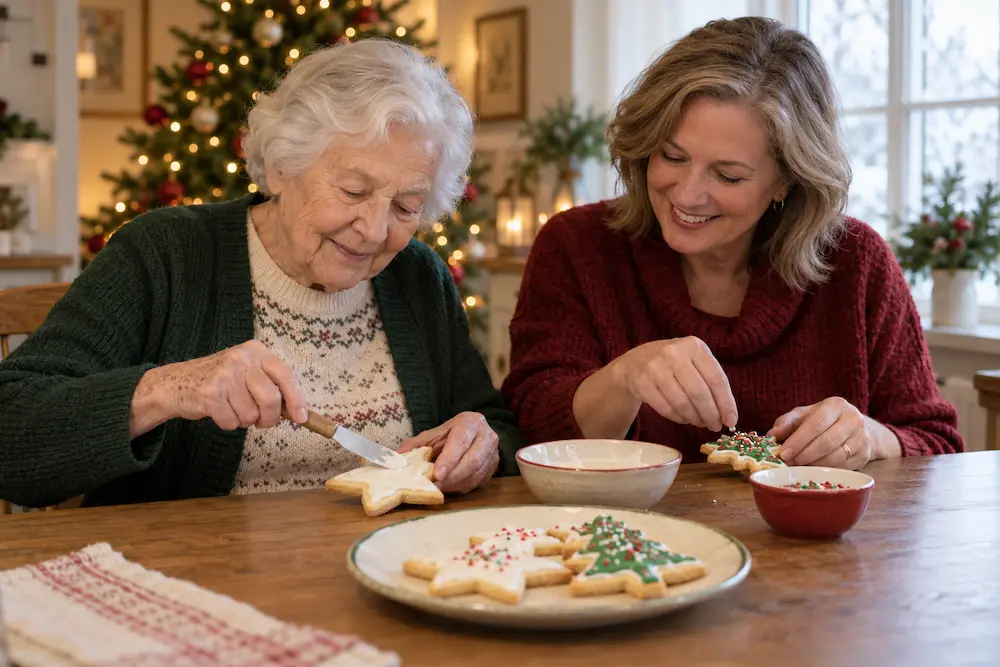
1. Holiday baking. Baking is wonderful because it engages every sense. Stirring, sprinkling, decorating and (best of all) tasting are all things a person can do at their own level. Let them do the easy jobs, like pressing cookie cutters into dough or sprinkling on the colored sugar. Don’t worry about perfection.
2. Handmade gifts. In my opinion, nothing says “I love you” like a handmade gift. It can be as simple as filling a jar with candy or as involved as a knitted scarf. Use the skills you already have, and let your loved one help in whatever way they can.
3. Keep your holiday traditions. Almost every family has a few: a special cookie recipe, a Christmas morning breakfast, a drive to see Grandma. Routine can help someone with dementia feel safe in a world that feels uncertain, so weave their usual routines into your traditions rather than replacing them.
4. Reminiscing. The holidays naturally invite stories about Christmases past. Photos, old ornaments and holiday cards make wonderful prompts. Ask open-ended, specific questions like “What did your mother always cook on Christmas Eve?” instead of “Do you remember…?” Long-term memories are often easier to reach than recent ones, and sharing them can be very comforting.
Learn tips and ideas on how to talk to someone with dementia.
Downloadable PDF checklist and workbook
Get It Here
5. Caroling. It’s an old tradition, I know, but it’s still a wonderful one. If you can’t get out to sing with your neighbors, have your very own private caroling session at home. Song sheets with large print help.
6. Look at Christmas lights. A drive or a gentle stroll to see the lights gets you some fresh air and gives you something pretty to talk about. Go early in the evening if dusk is a difficult time for them, or take the drive in the car so they can stay warm. Avoid anything with flashing or blinking displays, which can be disorienting.
7. Decorate together. Putting up decorations is a great way to get into the spirit. Making a wreath for the front door is one of my favorites. Keep it simple, though. A few meaningful pieces are better than a house so full of décor that it becomes confusing or hard to walk through.
8. Make ornaments. Buy a kit, knit or crochet a few, or put something together with a hot glue gun (you hold the glue gun, though). Salt dough, paper snowflakes and painted pinecones are easy and forgiving. So many Christmas craft ideas to choose from!
9. Make holiday cards. Handmade cards are a thoughtful way to show someone you care, and they keep the mind and hands busy. Here’s a tip: save last year’s cards, cut out the images and paste them onto construction paper to create brand-new ones.
10. Listen to holiday music. Music is one of the most powerful tools we have. Familiar songs can bring back happy memories, lift a mood and even calm a tense moment. One 2018 study of adults at a community health center found that just 20 minutes of music could boost mood and thinking.
Choose the songs from their younger years, keep the volume low and turn off the TV so there’s only one sound competing for attention.
11. Attend a holiday concert. If your community or church offers one, and your loved one isn’t bothered by crowds, it can be a lovely outing. Sit near the back or on an aisle so you can slip out if needed. If crowds and noise are a problem, watch a concert at home on TV or YouTube instead.
12. Watch holiday movies. Familiar classics are comforting. Some favorites include It’s a Wonderful Life, Miracle on 34th Street, Home Alone, A Charlie Brown Christmas, Holiday Inn and How the Grinch Stole Christmas. For some people, older, slower-paced films work better than fast-moving modern ones.
13. Wrap gifts. Wrapping is a simple, satisfying job. Try an unusual container, like a basket or a pretty tin, if folding paper has become tricky. Fancy bows are great fun.
14. Share some love. The holidays bring out the good in most of us. Make blankets or crafts to take to a nursing home or women’s shelter, or volunteer together at an animal shelter. Helping others gives a sense of purpose.
15. Go shopping, or just window shop. Most malls and downtowns are festively decorated, and a stop for coffee or tea makes it an outing. I’d recommend going during off-peak hours to avoid overstimulation.
16. Put together a raffle basket for a local charity. Have the kids or grandkids help you fill a basket of goodies. It’s a fun family project and a great way to give back.
17. Stay connected. Video calls on an Echo Show, FaceTime or Zoom are a wonderful way to see far-away family. Keep calls short, ask the caller to be in a quiet spot with good lighting, and have someone sit alongside your loved one to help.
18. Set a special table. A holiday dinner deserves a pretty table. Let your loved one fold napkins, place the silverware or arrange a centerpiece. Use plain, contrasting plates so the food is easy to see, and skip the busy patterns.
19. Play board games. As long as you can find a simple game your loved one can enjoy, this can be a great way to spend time together. Keep the rules few and don’t keep score. Check out these great board games for seniors with dementia.
20. Dress up. Many families do special photo cards where everyone dresses up, so why not take that tradition and bring it to the holiday dinner itself? Pick a theme and have fun.
Some ideas:
- western wear (I do wonder what cowboys ate on Christmas Day!)
- a Hawaiian luau with grass skirts
- Victorian outfits
- The Jetsons
You can even plan the meal around the theme.
Bonus: Sensory Ideas
As dementia progresses, activities often need to be simpler and more sensory-based. A few options:
- Familiar scents like cinnamon, pine, orange peel or fresh-baked cookies. Keep them mild, since strong smells can be overwhelming. Read more about aromatherapy for dementia.
- Textures to touch, such as a soft blanket, a velvet ribbon or a basket of pinecones. Fidget blankets can be excellent for seniors with moderate to advanced dementia.
- Gentle hand massage with a lotion they like, which many people find very soothing in the later stages.
- Soft music playing in the background.
Research on sensory therapy has found that it can reduce agitation in people with dementia, though every person is different. If something seems to upset your loved one, stop and try something else.
Don’t Forget Holiday Safety
I can’t help myself on this one, since safety is such a big part of what I do.
The holidays bring candles, extension cords, glass ornaments, a tree that needs watering and plenty of clutter, all things that can be risky for someone with dementia.
- Use flameless LED candles instead of real ones.
- Skip ornaments that look like food or candy, such as fake fruit, because they can be mistaken for the real thing.
- Keep cords tucked away and the walkways clear so no one trips.
- Make sure poinsettias and mistletoe are out of reach, since they can irritate the mouth and stomach if swallowed.
- Keep medications put away when you have visitors.
- Watch for increased wandering when there’s more activity and the door is opening and closing.
Frequently Asked Questions
What are the easiest activities for someone with dementia?
Dementia can make it hard to do things that require a lot of coordination or mental effort, but there’s still plenty a person can enjoy. The best activities are familiar and comfortable. Some of my favorites:
- Listening to music
- Looking at photo albums
- Chatting with family and friends
- Gardening
- Simple arts and crafts
- Sorting buttons, socks, nuts and bolts, or coins
- Folding towels, clothing or sheets
- Preparing a simple sandwich or snack
Staying active and engaged supports mood, sleep and appetite, and it can ease boredom, depression and anxiety. Just remember that what was easy 30 days ago may not be easy today. As the disease progresses, abilities change, so be ready to adapt.
What are meaningful activities for someone with dementia?
Meaningful activities give purpose to a person’s day. They might be spending time with loved ones, going for a walk or looking at old photos. At Christmas, think about:
- Wrapping gifts
- Making ornaments
- Decorating the tree
- Putting together a scrapbook of family photos
- Baking holiday treats
- Polishing the silver before the big meal
- Dusting and tidying
The key is to tailor the activity to the individual. A retired carpenter may love sanding a wooden ornament, while a former teacher might love reading a holiday story out loud. Think about what the person did for a living and what they loved.
What games are good for people with dementia?
Look for games that are enjoyable but not frustrating. A few ideas:
- Word games like Scrabble, Boggle or crosswords, if the person has always enjoyed them.
- Card games such as Go Fish or War, which are simple and familiar.
- Board games like Connect 4 or Qwirkle, which help with visual tracking and hand-eye coordination.
- Puzzles, including large-piece jigsaws, which are satisfying to complete.
- Movement games like Simon Says, balloon volleyball or Wii bowling, which get people up and moving.
Every person is different. If a game causes stress, put it away and try something else. The goal is enjoyment, not winning.
What is an Alzheimer’s busy box?
An Alzheimer’s busy box (sometimes called a fidget box or activity box) is a small, portable activity center that provides gentle stimulation and helps keep a person occupied. It typically includes things to turn, slide, flip or press, such as knobs, beads, switches and buttons. Some also have music and lights.
For a caregiver, a busy box can offer a moment of respite, and it can help with boredom and restlessness. Keep in mind it’s a tool, not a cure-all. You can make your own or purchase one. [add links]
Are puzzles good for people with dementia?
They can be. Puzzles offer a chance to problem-solve and the satisfaction of completing something. Here are some great puzzles for seniors with dementia.
Choose the difficulty level carefully: too hard, and it becomes frustrating, while too simple can feel insulting. Large-piece puzzles with familiar images, like holiday scenes, are a great place to start.
The Bottom Line
With a little creativity and planning, people living with dementia or Alzheimer’s can still experience the joy and warmth that Christmas brings. You don’t have to do it all. Pick a few activities, keep things calm and simple, and focus on being together.
And please, be gentle with yourself, too. You’re doing something hard and loving, and that’s what matters most.