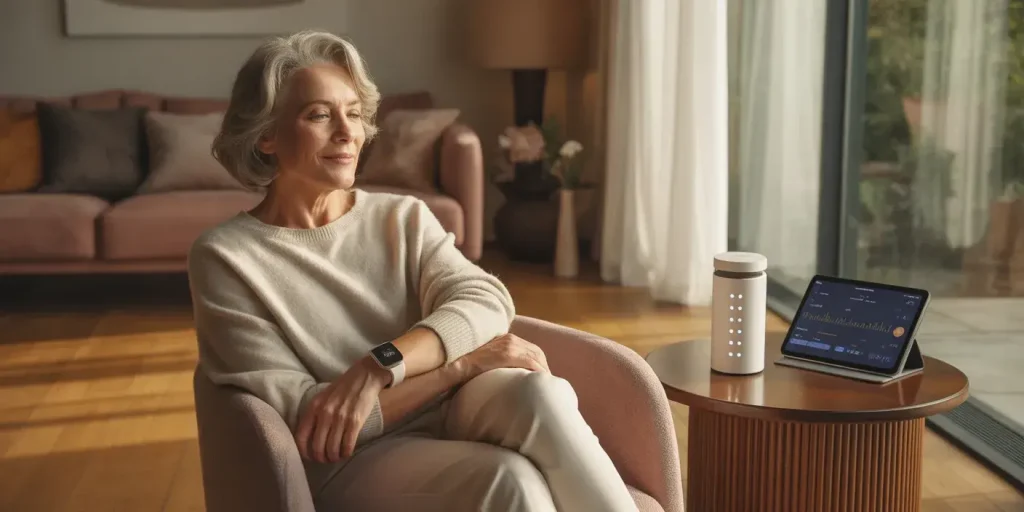
| What are the most important innovative aging trends in 2026? The biggest aging trends in 2026 center on technology, personalized care, and staying independent at home. Wearable health monitors, AI-assisted caregiving tools, age-friendly smart home devices, and community-based support programs are changing how older adults live and get help. These advances make it easier to stay safe, connected, and in control. |
A New Chapter in Getting Older
Ellie is 79 years old, lives alone in the house she has owned for 40 years, and last spring she called me with a question I hear often: “Esther, is it still realistic for me to stay home?”
By the end of our conversation, I wasn’t just reassuring her. I was genuinely excited about the tools and programs now available to people like her.
Now, I admit, I love gadgets and technology so that was a fun and easy conversation for me to have with Ellie.
What I’ve seen in 2026 is a real shift. Aging is no longer just about managing decline. It’s about designing a life that fits who you are, where you want to live, and how much help, or how little, you need day to day.
This article walks you through the most meaningful aging trends right now. Whether you are planning your own future or helping someone you love, these shifts matter.
So, keep reading to find out what’s changing, and how to use it.
What Are the Biggest Innovative Aging Trends in 2026?
The most significant aging trends in 2026 combine technology with human connection. Smart wearables, AI-powered home monitoring, telehealth expansion, and community care models are leading the way.
Together, they give older adults more options, more control, and more peace of mind, without requiring a move to a care facility.
Here is a quick look at the core trends shaping aging in 2026:
- Wearable health monitors that track falls, heart rate, and sleep
- AI-powered medication reminders and emergency alert systems
- Smart home devices designed specifically for older adults
- Telehealth and virtual therapy options that reduce travel barriers
- Village and community networks that coordinate neighbor-to-neighbor support
- Age-inclusive design in housing, public spaces, and consumer products
- Cognitive wellness programs targeting brain health and dementia prevention
Why Are These Aging Trends Growing So Quickly Right Now?
These trends are growing because the older adult population is larger, more tech-savvy, and more vocal than any previous generation.
The U.S. Census Bureau projects that adults 65 and older will outnumber children under 18 by 2034. That demographic shift is pushing developers, healthcare providers, and communities to respond with better, smarter options.
Older adults today are not the same as older adults 20 years ago. Many are comfortable with smartphones, confident with video calls, and actively searching for solutions that help them stay home safely.
At the same time, family caregivers are stretched thin. More adult children live far from aging parents. More seniors live alone. The demand for tools that bridge that gap has never been higher.
What Specific Technologies Are Changing Aging at Home?
Several specific technologies are making a real difference for older adults who want to stay home.
These include passive monitoring systems, voice-activated assistants built for older users, fall-detection wearables, and smart pill dispensers. Each one addresses a common barrier to independent living, often without requiring a caregiver to be physically present.
Here are some of the most practical innovations I recommend looking into:
- Passive monitoring: Devices like motion sensors and radar systems that track daily patterns without cameras or wearables.
- Fall detection wearables: Smartwatches and pendants that automatically call for help after a fall, even if the person is unconscious.
- Functional Mobility Aids: The latest robotic wheelchairs and assistive devices are being built with autonomous navigation, allowing them to open doors or gently pull products from store shelves to maximize user independence.
- Smart pill dispensers: Automated dispensers that alert a caregiver if a dose is missed
- Voice assistants designed for seniors: Simplified devices with larger text, louder speakers, and elder-focused apps.
- Remote patient monitoring: Blood pressure cuffs and glucose monitors that send readings directly to a care team.
- Smart Bathroom Diagnostics: Innovation is moving straight into daily routines. Smart toilets that automatically analyze urine for hydration, protein levels, or early infection markers, and AI-powered toothbrushes that screen breath for volatile biomarkers, are giving people a continuous, non-invasive look at their baseline health.
- Immersive Engagement: Virtual reality (VR) and augmented reality (AR) are being utilized not just for entertainment, but as clinical tools for deep emotional connection, therapeutic memory recall, and cognitive stimulation.
As an OT, I always ask: will this person actually use this tool? The best technology is the one that fits naturally into someone’s day. That’s why I focus on devices that feel like help, not surveillance.
How Does Technology-Supported Aging Compare to Traditional Caregiving?
Technology does not replace human caregiving. It extends it. A smart monitoring system cannot hug someone after a hard night, but it can alert a family member at 2 a.m. when something seems off.
The best aging plans in 2026 combine human warmth with smart tools that fill in the gaps.
| Traditional Caregiving Approach | Technology-Supported Aging Approach |
| In-person check-ins scheduled by family | Passive sensors alert family if routines shift |
| Manual medication tracking | Smart dispensers manage and log each dose |
| Relying on landline or phone calls for help | Wearables detect falls and call automatically |
| In-office doctor visits for routine checks | Remote monitoring sends vitals to the care team |
| Caregiver must be nearby or available | Family stays connected from any location |
| Memory or mood tracked by observation | Apps and devices flag cognitive or behavioral changes |
What Should You Do to Take Advantage of These Aging Trends?
Start by identifying the one or two biggest challenges in your current daily life. Are you worried about falls? Medication errors? Feeling isolated?
Once you name the problem, you can find a tool or program that fits. You don’t need to adopt every trend. You need the right solution for your specific situation.
| What should older adults do to benefit from aging innovations in 2026? The best first step is a home safety or aging-in-place assessment from a certified professional such as a CAPS or OT. From there, choose one or two tools that address your real daily challenges. Start simple, add gradually, and involve family in the process. Small, practical changes make the biggest long-term difference. |
I worked with a woman named Dorothy, 81, who was terrified of falling in her bathroom. She resisted every suggestion until we installed a simple grab bar and a waterproof voice-activated alert device.
Six months later, she called me to say she finally showered without fear. That one change gave her back her confidence.
Here’s how I recommend getting started:
- Schedule a home assessment with a CAPS-certified specialist or occupational therapist
- Make a list of daily tasks that feel risky or hard
- Talk with your doctor about remote monitoring or telehealth options
- Contact your local Area Agency on Aging for free or low-cost programs
- Involve family members or trusted friends in choosing new tools
What Tools and Programs Are Available to Support Aging in 2026?
Older adults have more support options in 2026 than ever before. Local, national, and digital resources are available for nearly every need, from transportation to cognitive health programs to in-home support.
Many are low-cost or covered by Medicare, Medicaid, or supplemental insurance plans.
Here are some of the most valuable resources right now:
- AARP HomeFit Guide: Free tool to assess your home for aging-in-place readiness
- Area Agencies on Aging (AAA): Government-funded local offices connecting seniors to services and programs
- Medicare’s telehealth benefits: Now cover a wide range of virtual visits including mental health and therapy
- Village networks: Community membership organizations run by older adults for older adults, offering rides, errands, social connection, and home help
- Aging Life Care Managers: Professionals who help coordinate complex care plans and navigate systems
- PACE programs (Program of All-inclusive Care for the Elderly): For those who qualify, PACE provides comprehensive medical and social support to help people remain at home
When Should You Be Worried and Take Action Quickly?
You should take action quickly when an older adult shows signs of cognitive decline, frequent falls, medication mismanagement, social withdrawal, or trouble managing basic daily tasks. These are not just normal parts of aging.
They are warning signs that more support is needed now, before a crisis occurs. Early action gives you far more choices.
As a clinician, I’ve seen families wait too long because they didn’t want to upset their parent.
But waiting until a fall or hospitalization dramatically narrows your options. The goal is to act early, when things are still manageable.
Watch for these signs that it’s time to act:
- Repeated falls or near-misses in the last 3 months
- Missed medications more than twice in a week
- Significant weight loss without explanation
- Confusion about time, place, or familiar people
- Withdrawal from activities, friends, or family
- Bills going unpaid or financial mistakes increasing
- Home becoming cluttered, unsanitary, or unsafe
You Have More Options Than You Think
I’ve spent decades walking into people’s homes and helping them figure out what’s possible. And I can tell you honestly: this moment in 2026 is one of the most hopeful I’ve seen for older adults and their families.
The tools are better. The programs are more accessible. The mindset is shifting from fear of aging to planning for it.
Whether you’re 65 or 85, whether you’re planning for yourself or someone you love, the most important step is the first one. Start with one conversation, one assessment, or one small change. That’s how Ellie found her footing, and how Dorothy got her shower back.
You don’t have to do this alone. And in 2026, you have more help than ever before.