Your mother called you nine times between eleven at night and four in the morning. Each time she was surprised to hear your voice, and each time she hung up and called again. By the third call you were awake for good, and by the ninth you were angry at yourself for being angry at her.
That pattern, or some version of it, is usually the moment families start looking for a different phone. Sometimes it arrives the other way around, with a parent who cannot complete a call at all anymore and who sits with the phone in her lap, waiting.
In my years working with older adults in their homes, the cell phone was one of the most reliable early indicators that something had shifted cognitively. Long before anyone was ready to talk about a diagnosis, the phone stopped working the way it used to.
What actually breaks first
It is rarely the whole device. It is the sequence.
Placing a call requires holding several steps in working memory at once: unlock the screen, find the right icon, scroll a list, match a name to a person, tap once and only once, then wait through silence for someone to answer. Any one of those steps can drop out while the others stay intact, which is why a parent can seem perfectly capable in conversation and still be unable to reach you.
The second thing that breaks is judgment about incoming calls. A person who would never have handed a stranger her bank information in her own kitchen will do exactly that for a confident voice on the phone claiming to be from Medicare. Scam callers work this population deliberately, and repeated exposure matters more than any single call.
The third is call frequency, in both directions. Repetitive calling at night, calls to a spouse who died years ago, or an emergency call placed to 911 for something that is not an emergency. None of these mean your parent is being difficult. They mean the phone is offering more options than she can currently manage.
What a simplified phone changes
Phones built for memory loss share one design principle: the person using the phone does not have to configure anything, and the person managing the phone does not have to be in the room.
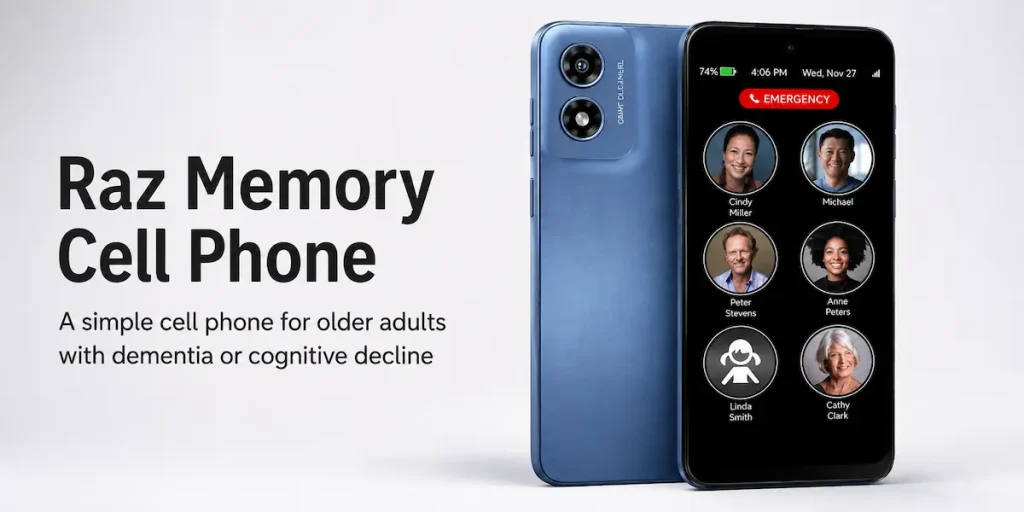
The RAZ Memory Cell Phone is the clearest example of the category, and it is worth walking through because the feature list shows you what to look for even if you choose something else. The home screen shows large photographs of contacts, and a call is placed by pressing and holding a picture. There are no applications and no settings the user can reach.
The management happens on your phone instead. Through a companion app on your own iPhone or Android, you add and edit contacts, change settings, and check status information including phone location, signal strength, and battery level. That matters enormously when you live four states away and cannot troubleshoot in person.
Several features map directly onto the three failure patterns above. Incoming calls can be limited to contacts and approved numbers, which shuts down robocalls and scam attempts.
Quiet hours block calls to specified contacts during set times of day, and a repetitive call limit caps how many times your parent can call one person in a given period. You can record a message she hears when she calls during those hours, saying you love her and to call again in the morning.
There is also a mode with oversized, high contrast buttons intended for people with hand tremors from Parkinson’s disease or stroke, or low vision from eye disease. Occupational therapists rarely see cognitive change in isolation, and a phone that accommodates tremor and vision at the same time is doing real clinical work.
Reminders can be scheduled to appear as text or as a recorded audio message, and the app shows you whether the reminder was acknowledged. That acknowledgment field is more useful than it sounds. It is a low-friction way to know something happened without calling to check.
Repeat 911 calls have their own solution. RAZ offers a subscription service that routes emergency calls to a private dispatch service instead of directly to 911, texts caregivers so they can interact with the dispatcher, and lets the agent contact 911 or cancel as appropriate.
A separate free feature simply texts you when your parent dials 911. If your family has been through a cycle of ambulances arriving for imagined emergencies, that distinction is worth understanding.
Buy the case for the RAZ Memory Cell Phone

- Compatibility: Engineered exclusively for Moto G Play 2024 with precision cutouts that give full access to ports, speakers, and buttons without interfering with wireless charging. Our 24/7 dedicated support team resolves any model or quality concerns instantly.
The one thing it is not
A phone with an emergency button on the screen is not a medical alert system.
This confusion costs families dearly, so I want to be plain about it. An emergency button requires your parent to be conscious, oriented enough to recognize that she needs help, and physically able to reach and operate the device. A person who has fallen and struck her head meets none of those conditions, and a phone left charging in the kitchen meets none of them either.
If your parent has fall risk factors, and most people with cognitive decline do, she needs a wearable medical alert pendant with automatic fall detection, worn on the body, in addition to whatever phone she uses. These are two different tools solving two different problems. Buying the phone and calling the safety question settled is the mistake I saw most often.
Before you buy
Ask whether the phone is unlocked and whether you can keep the existing number and carrier. The RAZ is unlocked and works with most major providers in the US and Canada, including Verizon, AT&T, T-Mobile, Mint Mobile, Consumer Cellular, and others. Keeping a familiar number is not a small thing for someone with memory loss.
Ask what the monthly service costs and what is bundled. RAZ offers three free months of service with purchase and twenty dollars per month after that, though you can also bring your own plan.
Ask what happens when it breaks. RAZ replaces a phone seriously damaged by drops or water in the first twelve months for a fee, provided you bought a protective case with the original phone.
And ask what support exists for you, not just for the device. RAZ runs a free dementia helpline at 800-729-0083 where you can schedule a call with a dementia care specialist, which is available whether or not you are a customer.
The conversation with your parent
Introduce the phone as a solution to a problem she already knows she has. Most people in early cognitive decline are painfully aware that the phone has become difficult, and they are relieved when someone names it without pity.
If your parent still has decision-making capacity and tells you no, that answer stands. You can revisit it, you can ask what specifically she objects to, and you can try again in three months when circumstances have changed. What you cannot do is override a competent adult because the alternative is more convenient for you.
Set it up alongside her rather than presenting it finished. Let her choose which photographs go on the home screen and in what order, because those six faces are the entire interface and her associations are more reliable than your logic.
The takeaway
The goal is not to give your parent fewer capabilities. It is to remove the steps she can no longer complete so the ones she can still do actually work. A phone she can use is a phone she will use, and that is worth more than every feature she cannot reach.