The Assessment Families Often Get Too Late
- Open with a familiar pattern: an older adult falls, goes to the ER or hospital, and suddenly everyone starts looking at grab bars, stairs, rugs, lighting, and bathroom safety.
- Explain that during my years in occupational therapy, I often saw home safety become a priority after something happened.
- Introduce the central idea: a fall should not have to be the event that tells you a home needs attention.
- Reassure readers that getting an assessment does not automatically mean expensive remodeling or taking away a parent’s independence.
Should You Get a Home Safety Assessment Before a Fall?
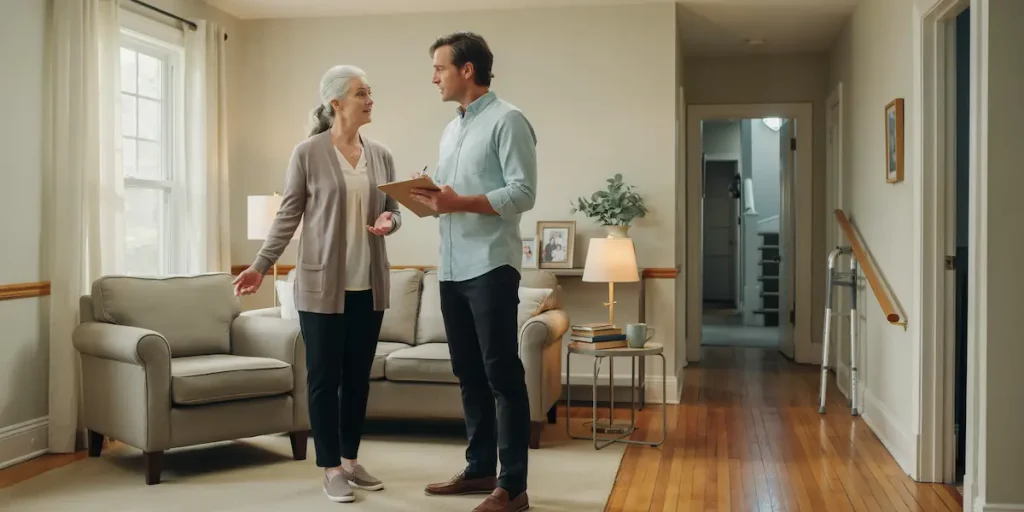
Yes. A home safety assessment is most useful before an older adult has a serious fall. It can identify changes in balance, mobility, vision, strength, habits, and the home itself while there is still time to make thoughtful changes instead of making decisions during a crisis.
Why “They Haven’t Fallen Yet” Can Give Families False Reassurance
Explain that absence of a fall does not equal absence of risk.
Discuss warning signs families often overlook:
- Holding onto furniture while walking
- Touching walls for balance
- Pausing before stepping into the shower
- Struggling to stand from a chair
- Avoiding stairs
- Leaving lights on because dark rooms feel harder to manage
- Taking smaller or slower steps
- Having trouble turning around in tight spaces
- Nearly falling but catching themselves
Make the distinction that a near-fall is useful information, even if nobody was injured.
Clinical observation: people often compensate for declining balance long before the family realizes anything has changed.
The House May Be the Same, But Your Parent Isn’t
This should be one of the stronger sections of the article.
Explain that families often say:
“She’s lived in this house for 30 years and never had a problem.”
The problem is that the environment may not have changed, but the person using it has.
Discuss normal and health-related changes involving:
- Muscle strength
- Reaction time
- Balance
- Vision
- Depth perception
- Joint flexibility
- Foot sensation
- Endurance
- Medication effects
- Cognitive changes
Use a practical example such as stepping over the side of a bathtub. At age 60 it may require almost no thought. At age 82, reduced hip motion, balance, and leg strength can turn the same movement into a significant challenge.
A home becomes unsafe when the demands of the environment begin to exceed the person’s abilities.
What a Good Home Safety Assessment Actually Looks At
Move beyond the idea of someone simply walking around looking for throw rugs.
Explain that I would want to see how the person actually functions in the home.
Getting Around the Home
Look at:
- Walking paths
- Furniture placement
- Walker or cane use
- Doorway widths
- Thresholds
- Changes in flooring
- Stairs and railings
Getting Up and Sitting Down
Observe:
- Favorite recliner
- Dining chair
- Toilet
- Bed
- Sofa
Explain why struggling to stand can reveal leg weakness, poor furniture height, or unsafe compensating strategies.
Using the Bathroom
Observe real movements such as:
- Stepping into the shower
- Turning inside the shower
- Reaching for faucets
- Sitting on and standing from the toilet
- Walking to the bathroom during the night
Explain why the bathroom often combines several risks at once: water, hard surfaces, restricted space, transfers, and clothing management.
Everyday Tasks
Consider:
- Cooking
- Carrying laundry
- Reaching into cabinets
- Bringing groceries inside
- Getting mail
- Caring for pets
- Taking medications
- Getting in and out of the house
This is where the occupational therapy perspective can make the article different from a typical home-safety checklist.
Pay Special Attention to What Happens at Night
Discuss why daytime assessments can miss important hazards.
Walk the reader through the 2:00 a.m. trip to the bathroom:
Bed → standing up quickly → finding glasses → walking in low light → possibly feeling groggy → navigating furniture → entering the bathroom → using the toilet → returning to bed.
Point out how several small risks can stack together.
Potential recommendations can include:
- Clear walking paths
- Nightlights
- Motion or light-sensing illumination
- Easy-to-reach bedside lighting
- Proper footwear
- Stable furniture
- Accessible mobility devices
Small Problems Are Easier to Fix Before They Become Big Problems
Explain that home safety assessments do not always lead to major remodeling.
Give examples of early interventions:
A person hesitates on stairs → improve lighting and handrails.
A person struggles from the toilet → consider toilet height or strategically placed grab bars.
A person catches a walker on a rug → remove or secure the rug.
A person cannot safely reach dishes → reorganize frequently used items.
A person struggles at the front step → add a secure handrail before a ramp or larger modification becomes necessary.
This section should emphasize that early assessment often creates more choices, not fewer.
A Home Safety Assessment Is Really an Independence Assessment
This is an important emotional reframing.
Families sometimes think an assessment means:
“We’re deciding whether Mom can still live here.”
Instead:
“We’re looking for ways to make it easier for Mom to continue living here.”
Explain that good aging-in-place planning supports independence by reducing unnecessary demands on the older adult.
The goal of a home safety assessment is not to find reasons someone cannot live at home. It is to find ways to help them function there more safely.
When I Would Recommend an Assessment Even Without a Fall
Rather than creating a generic “tips” list, frame these as changes that deserve closer attention.
An assessment may be worth considering when you notice:
- A new cane or walker
- Arthritis or increased pain
- A recent hospitalization
- Changes in vision
- New dizziness
- Parkinson’s disease
- Stroke
- Neuropathy
- Increasing weakness
- Memory or judgment changes
- Difficulty getting into the shower
- Trouble managing stairs
- Furniture walking
- Near-falls
- Fear of falling
- Avoidance of certain rooms or activities
Also mention that a change in function can be more important than a particular birthday. There is no magic age when every home suddenly needs an assessment.
DIY Home Safety Check or Professional Assessment?
Explain that families can absolutely identify many obvious hazards themselves.
A DIY check may uncover:
- Loose rugs
- Poor lighting
- Cluttered pathways
- Missing handrails
- Electrical cords across walking areas
- Frequently used items stored too high
- Unstable furniture
But explain where professional eyes become valuable.
A trained professional may notice how the person performs a task, rather than simply whether the environment looks safe.
For example:
The shower may already have grab bars.
The important question is whether they are located where this particular person naturally reaches while entering, turning, and standing.
Discuss professionals families might encounter, including occupational therapists and Certified Aging-in-Place Specialists, while making clear that credentials and scope of practice differ.
Don’t Forget the Person While You’re Fixing the House
This section prevents the article from implying that all falls are caused by environmental hazards.
Discuss other fall-risk factors that may need attention:
- Medication side effects
- Blood pressure changes
- Vision problems
- Foot problems
- Poorly fitting shoes
- Muscle weakness
- Balance problems
- Dehydration
- Illness
- Cognitive impairment
Recommend talking with the person’s healthcare provider when appropriate, particularly if there has been dizziness, sudden weakness, fainting, new balance problems, or repeated near-falls.
Fall prevention works best when you look at both sides of the equation: the person and the environment.
How to Suggest an Assessment Without Frightening Your Parent
Address the likely family dynamic.
Avoid:
“We need someone to see whether you’re safe living here.”
Try framing it around comfort and independence:
“I’d like someone to look at the house and see if there are things we could change now that would make everyday tasks easier.”
Explain why involving the older adult in decisions matters.
Ask:
- What feels harder than it used to?
- Is there anywhere in the house you feel less steady?
- Are there things you’ve stopped doing?
- Is there anything you wish were easier?
Their answers may reveal more than simply inspecting the house.
Don’t Wait for the Ambulance to Start Looking Around
Bring the article back to the opening.
Explain that after a serious fall, families may suddenly be making decisions about equipment, rehabilitation, home modifications, caregiving, and discharge planning all at once.
Before a fall, there is time to:
- Talk
- Observe
- Compare options
- Make smaller changes
- Try solutions
- Get the older adult’s input
End on reassurance rather than fear.
You cannot prevent every fall. But you do not need to wait for a fall to start asking whether the home still fits the person living in it.
That, to me, is the real value of doing the home safety assessment first.