You drove home from Mother’s Day with a knot in your stomach.
Maybe she moved slower than you remembered. Maybe the kitchen was cluttered in a way it never used to be. Maybe she repeated the same story three times, or you noticed bruises she couldn’t explain.
Whatever you saw, you can’t stop thinking about it.
That feeling is worth paying attention to. Adult children who visit infrequently often catch changes that gradual caregivers miss entirely.
If something felt off during your Mother’s Day visit, trust that instinct, and use this list to help you figure out what you actually saw.
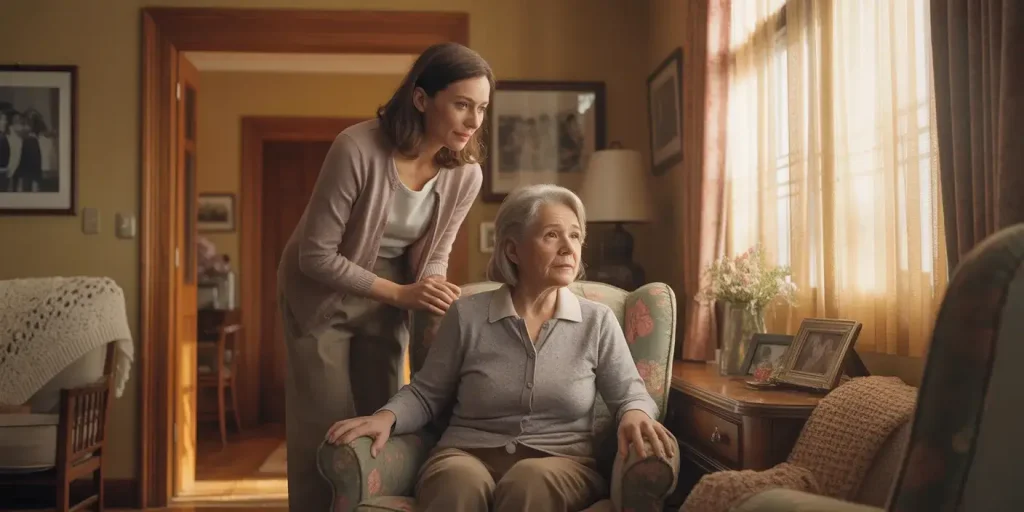
What Does It Mean When Your Elderly Mom Seems Different?
| Answer Capsule: Noticeable changes in movement, memory, weight, home upkeep, or social habits can signal that an elderly parent needs more support. These changes are often gradual and easier to spot during an infrequent visit than in daily life. |
When you haven’t seen someone in a few months, changes stand out. That’s actually an advantage. You’re not adjusting to a slow decline, you’re seeing a snapshot. Here are seven warning signs that deserve a closer look.
Warning Sign #1 – She’s Walking Slower or More Carefully
A change in gait, how someone walks, is one of the most reliable early indicators that something is going on. It’s not just about aging.
Slower or more cautious walking can signal:
- Pain she hasn’t mentioned (arthritis, hip problems, foot issues)
- Fear of falling, she may have already had a near-fall and not told you
- Medication side effects that affect balance
- Early signs of Parkinson’s disease or other neurological changes
- Inner ear problems affecting her equilibrium
Watch how she walks from room to room, not just when she knows you’re watching. Is she holding onto furniture? Taking smaller steps than before? Hesitating at thresholds or steps? These details matter.
A physical therapist (PT) evaluation can pinpoint the exact cause and recommend targeted interventions, from exercises to assistive devices. This is worth pushing for, especially if you noticed shuffling, stooping, or uneven steps.
Warning Sign #2 – The House Tells a Story
Homes reflect the people living in them. When someone is struggling, the home often shows it before they do. Look for:
- Unwashed dishes or piled-up mail that wouldn’t have been there before
- Spoiled food in the refrigerator
- Clutter in pathways or furniture rearranged for support
- Burned pots or evidence of a forgotten stove
- A bathroom that hasn’t been cleaned in a while
- Unpaid bills visible on the counter
One messy kitchen doesn’t mean there’s a crisis. But if the overall upkeep is noticeably different from what you’d expect, that’s meaningful information.
She may be conserving energy, avoiding tasks that are now physically difficult, or struggling with executive function, the brain’s ability to plan and follow through.
Warning Sign #3 – She’s Lost Weight Without Explanation
Unintentional weight loss in older adults is a red flag that physicians take seriously. It can point to:
- Difficulty cooking or shopping for food
- Swallowing problems (dysphagia) that make eating uncomfortable
- Depression or grief causing loss of appetite
- Medication side effects
- Undiagnosed illness
- Dental pain that makes chewing difficult
If she looks noticeably thinner and can’t give you a good reason why, that warrants a call to her doctor. A loss of 10 or more pounds without trying is a clinical concern, not just a casual observation.
Warning Sign #4 – Her Memory Seems Different
Repeating the same story in the same conversation. Forgetting who was at dinner last week.
Asking the same question multiple times. These are different from the normal forgetfulness that comes with aging.
Pay attention to:
- Repetition within a single visit, the same story or question more than twice
- Confusion about recent events (not distant ones, long-term memory often stays intact longer)
- Word-finding difficulty, long pauses, substituting wrong words
- Getting confused about the time of day or day of the week
- Difficulty following a conversation or losing track mid-sentence
Memory changes don’t automatically mean dementia, there are many treatable causes including medication interactions, thyroid problems, UTIs, depression, and vitamin deficiencies. But they do mean a medical evaluation is needed. Don’t wait and watch.
Warning Sign #5 – She Seemed Unsteady Getting Up or Sitting Down
Transitional movements, getting up from a chair, lowering onto a couch, stepping in or out of the bathtub, are when falls most often happen.
Watch specifically for:
- Using both arms to push off when rising from a chair
- Rocking or making multiple attempts before standing
- Grabbing onto nearby furniture or walls for support
- Sitting down too quickly or plopping rather than lowering
- Pausing before taking a step after standing
These movements reflect leg strength, core stability, and balance, all of which decline with age but can be improved with the right interventions.
If you saw this, ask about occupational therapy (OT) or physical therapy (PT) assessment. An OT can also evaluate her home for fall hazards and recommend grab bars, raised toilet seats, and other modifications.
Warning Sign #6 – Her Medications Are a Mess
Medication mismanagement is one of the leading causes of hospitalization in older adults, and one of the most preventable.
During your visit, take note of:
- Pill bottles with no system, scattered, mixed, or expired
- She can’t tell you what she takes or what each medication is for
- A pill organizer that isn’t being used or is clearly behind
- Refill dates that don’t add up (too many pills left, or bottles emptied too fast)
- Multiple prescribers who may not be coordinating with each other
A medication review by her primary care physician or pharmacist can catch dangerous interactions and simplify her regimen.
If managing daily medications is becoming too complex, a pill dispenser with alarms or a blister pack service from a pharmacy can help significantly.
Warning Sign #7 – She Mentioned She Hasn’t Been Going Out
Social withdrawal is both a warning sign and a health risk. When an older adult stops going to church, skipping her book club, turning down lunch invitations, or staying home when she used to go out regularly, it’s worth asking why.
Common reasons include:
- Fear of falling in public or unfamiliar environments
- Incontinence that makes outings feel risky or embarrassing
- Vision or hearing loss that makes social settings uncomfortable
- Depression or grief, especially after losing a spouse or close friend
- No longer feeling safe driving
Isolation significantly accelerates cognitive and physical decline. It’s not a personality quirk to shrug off. If she’s pulling back from the world, that’s a conversation worth having, gently, without pressure, but directly.
What Should You Do After a Worrying Mother’s Day Visit?
Don’t wait for a crisis to act. Here’s a practical starting point:
- Write down what you noticed while it’s still fresh, specifics matter when talking to her doctor.
- Call her primary care physician and share your observations. You don’t need her permission to give information to her doctor (though the doctor can’t share back without consent).
- Schedule a follow-up visit sooner than you planned. One data point is a concern. Two visits close together give you a comparison.
- Have a direct conversation with her, not an intervention, just an honest talk. Start with what you observed, not what you concluded.
- Consider a professional assessment. A geriatric care manager or occupational therapist can conduct a home safety evaluation and give you an objective picture.
The goal right now isn’t to solve everything. It’s to move from worried observer to informed advocate. You noticed something. That matters. Now follow through.
The Visit That Changes Everything
Mother’s Day visits are supposed to be celebratory. But sometimes they’re also clarifying. If this one left you unsettled, that’s not a bad thing, it means you were paying attention.
Changes in gait, home upkeep, weight, memory, balance, medications, or social habits are signals worth taking seriously. None of them are inevitable. Many are treatable. All of them are worth a conversation.
Your mom may not see what you saw. That’s okay. Your job right now isn’t to convince her of anything, it’s to make sure the right people are in the loop and that she’s getting the support she actually needs.
You drove home worried. Use that feeling to drive what happens next.