| What is the best kitchen lighting for seniors? Seniors need bright, even, glare-free lighting in the kitchen to see clearly and stay safe. Aging eyes require two to three times more light than younger eyes. The best approach combines overhead ambient light with under-cabinet task lighting over work surfaces. Using LED bulbs in the 3,000 to 4,000 Kelvin range gives the clearest, most comfortable light. |
My client Margaret called me one afternoon, frustrated and embarrassed. She had sliced her finger while chopping vegetables, but she insisted the knife was not to blame. “I just couldn’t see the cutting board clearly,” she told me.
Margaret was 78, sharp as a tack, and fiercely independent. Her kitchen was perfectly organized. But her lighting was stuck in 1987, a single ceiling fixture throwing dim, yellowish light into every corner.
What Margaret was experiencing was not carelessness. It was the natural effect of aging on vision. As our eyes age, they need significantly more light to process the same visual information. Poor kitchen lighting turns ordinary tasks like reading a recipe, measuring medication, or spotting a spill on the floor into genuine hazards.
In this article, I want to walk you through exactly how lighting affects safety in the kitchen, what changes make the biggest difference, and how to create a space where you can cook, eat, and live with confidence.
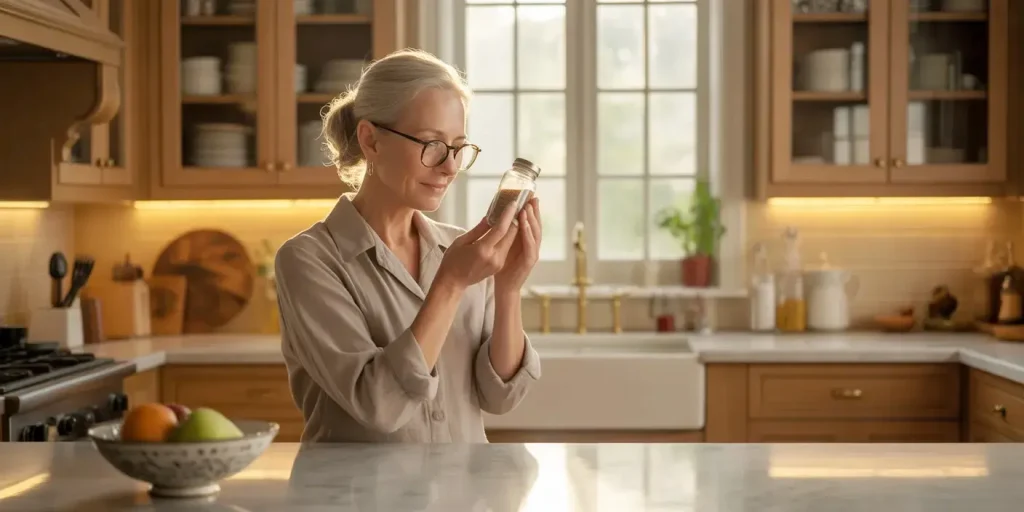
Why Does Kitchen Lighting Matter More as We Age?
Kitchen lighting matters more as we age because the aging eye requires far more light to function safely. By age 60, the average person needs roughly twice as much light as a 20-year-old to see the same level of detail. By age 75 or 80, that gap grows even larger. Reduced light means missed hazards, misread labels, and a higher risk of cuts, burns, and falls.
The pupil becomes smaller and less responsive with age, allowing less light to enter the eye. The lens also yellows slightly, which filters out blue-spectrum light and makes everything look a bit dimmer and more yellow-tinted.
Contrast sensitivity also decreases. This means it becomes harder to see the edge of a step, spot a light-colored pill on a white counter, or notice water on a tile floor. Good lighting does not just help you see more; it helps you see the differences between things that matter for safety.
What Are the Signs That Kitchen Lighting Is a Safety Problem?
You may have a kitchen lighting problem if you or a loved one is squinting, leaning in close to read labels, or avoiding the kitchen after dark. These are early warning signs that the current lighting is not meeting the visual demands of the space. Other signs include frequent spills that go unnoticed, difficulty reading medication instructions at the counter, or feeling anxious about using sharp tools.
Here are specific signs to watch for:
- Squinting or moving very close to counters or appliances to see clearly
- Difficulty reading labels on canned goods, spice jars, or medication bottles
- Missing spills or crumbs on the counter or floor
- Accidentally grabbing the wrong item from the pantry
- Feeling less confident about cooking, especially after dark
- Frequently turning on a phone flashlight to see something in the kitchen
- Eye fatigue or headaches after spending time cooking
If you recognize any of these, it is worth doing a simple lighting audit. Stand at your main work surface during the day and again at night. If the light level changes dramatically, your daytime natural light may be masking a real after-dark problem.
Normal Vision Challenge vs. Lighting-Related Safety Concern
| Typical Aging Change | Sign That Lighting Needs to Improve |
| Needing reading glasses for small print | Unable to read labels even with glasses in dim light |
| Adjusting slowly from bright to dim rooms | Avoiding the kitchen at night or in low light |
| Noticing more glare from headlights | Overhead light causes eye strain or makes it hard to focus |
| Taking longer to spot objects | Missing spills, pills, or knife edges on the counter |
| Reduced color contrast | Difficulty seeing the edge of the counter or steps |
What Are the Different Types of Kitchen Lighting, and Which Ones Do Seniors Need?
Kitchen lighting falls into three categories: ambient, task, and accent lighting. Seniors need strong ambient lighting as a base and bright task lighting directly over work surfaces. Accent lighting is mostly decorative but can help reduce dark spots.
The most important change most seniors can make is adding under-cabinet LED strips over every counter where food is prepared.
Here is a simple breakdown:
- Ambient lighting: overhead fixtures, recessed lights, or a ceiling fan with lights. This is your overall room light. It should be bright and even with no dark corners.
- Task lighting: under-cabinet strips, pendant lights over the island, or directional recessed lights aimed at the counter. This lights the actual work surface where cutting, reading, and cooking happen.
- Accent lighting: inside cabinets, toe-kick lighting along the base of cabinets, or above-cabinet lights. These reduce the contrast between bright and dark areas, which is especially helpful for seniors with low vision.
The color temperature of your bulbs also matters. Bulbs are measured in Kelvins (K). A bulb around 2,700K produces a warm yellowish light that feels cozy but can make it harder to distinguish colors and contrast.
A bulb around 3,500K to 4,000K produces a cleaner, crisper white light that is much easier on aging eyes without feeling harsh.
What Should You Do to Improve Kitchen Lighting for a Senior?
| What should you do to improve kitchen lighting for a senior? Start by adding bright LED under-cabinet lighting over every work surface. Next, replace dim overhead bulbs with high-lumen LEDs in the 3,000 to 4,000 Kelvin range. Add a night light or motion-sensor light near the entry and the sink area. These three changes address the most common lighting gaps in senior kitchens and can be done without major renovation. |
Here is what I typically recommend to clients and their families, in order of priority:
- Install LED under-cabinet lighting strips over every counter surface. Plug-in versions require no electrician and cost as little as $25 to $60 per strip.
- Replace all overhead bulbs with bright LEDs rated at 800 to 1,100 lumens per bulb. Choose a color temperature between 3,000K and 4,000K.
- Add a motion-sensor night light near the kitchen entry so it activates automatically when someone enters after dark.
- Use a high-contrast cutting board (dark board for light foods, light board for dark foods) to compensate for reduced contrast sensitivity.
- Place a small LED desk lamp or clip-on light near the spot where medications are counted and labels are read.
- Remove any hanging items or valances above windows that block natural daylight.
- Consider dimmer switches with a minimum brightness setting so lights are never accidentally left too low.
When I visited Margaret after we made these changes, she was beaming. She had gone back to making her weekly stews. She told me, “It feels like someone opened a window in my kitchen.” That is exactly the feeling good lighting should give you.
What Tools, Products, and Resources Can Help?
Several affordable, easy-to-install products can dramatically improve kitchen lighting without a full renovation. Motion-activated under-cabinet LED strips, battery-powered puck lights, and plug-in light bars are all available at hardware stores and online. For more significant upgrades, a licensed electrician can add recessed lighting or replace a single overhead fixture with a multi-bulb track light.
Products worth considering:
- LED under-cabinet light bars (plug-in, no wiring required): brands like Brilliant Evolution and Linkind are highly rated for brightness and ease of installation
- Smart bulbs with app or voice control: allow brightness adjustments without fumbling with switches
- Tap lights or puck lights: useful inside deep cabinets or pantries
- Motion-sensor floor night lights: plug into an outlet and activate when someone walks by
- Magnifying task light: a combination of magnification and bright LED light for reading small print
For professional guidance, an occupational therapist who specializes in home modification, or a CAPS (Certified Aging-in-Place Specialist) from the National Association of Home Builders, can assess your kitchen and recommend changes based on your specific vision and mobility needs.
A low vision optometrist can also evaluate how your eyes are responding to light and recommend solutions tailored to your diagnosis.
When Should You Be Seriously Concerned About Kitchen Lighting and Safety?
You should take kitchen lighting seriously as a safety issue if a fall, cut, or burn has already occurred in the kitchen, or if a senior is avoiding cooking because of fear or difficulty seeing. These are not minor inconveniences. Poor visibility in the kitchen is a direct fall and injury risk. If a senior with a dementia diagnosis is also having trouble in the kitchen, lighting changes become urgent, as visual confusion can accelerate disorientation and unsafe behavior.
Seek a formal home safety assessment if:
- A fall or near-fall has happened in the kitchen
- Medications are being misread or misdosed because labels are hard to see
- A person with dementia or mild cognitive impairment is using the kitchen alone
- The senior reports feeling unsafe or anxious in the kitchen after dark
- Vision loss has been diagnosed (macular degeneration, cataracts, glaucoma) and no lighting changes have been made
A CAPS professional or occupational therapist can complete a full kitchen safety evaluation and write up a prioritized list of modifications. Many of these evaluations are low-cost or covered through local Area Agency on Aging programs.
Final Thoughts: Small Changes, Big Difference
Margaret still calls me from time to time. She recently told me she hosted Thanksgiving dinner for the first time in three years. Better lighting did not give her a new kitchen. It gave her back her old one.
If you or someone you love is spending less time in the kitchen, cooking less, or feeling less confident than they used to, do not assume it is simply aging. Look up. Look at the light. Sometimes the most powerful aging-in-place tool is a $30 LED strip and a brighter bulb.
You deserve to see your life clearly, in every room, at every age. Start with the kitchen. It is one of the most important rooms in the house, and one of the easiest places to make a real difference.
If you would like personalized guidance, a home safety assessment with a CAPS or OT professional is a great first step. Your local Area Agency on Aging can connect you with services in your community, often at no cost.
Frequently Asked Questions
What is the best light bulb color temperature for seniors in the kitchen?
A color temperature between 3,000K and 4,000K is best. This range produces a clean, bright white light that makes it easier to see contrast and detail without the harsh blue glare of higher Kelvin bulbs.
How much does it cost to improve kitchen lighting for a senior?
Basic improvements like adding under-cabinet LED strips and replacing bulbs can cost as little as $50 to $150 total. More significant changes like adding recessed lighting typically run $200 to $600 depending on the number of fixtures and local labor rates.
Can poor lighting cause falls in the kitchen?
Yes. Poor visibility reduces the ability to spot wet floors, uneven surfaces, dropped items, and step-downs between surfaces. The kitchen is one of the most common rooms where senior falls occur, and lighting is a controllable risk factor.
Should seniors use LED or fluorescent bulbs in the kitchen?
LED is the better choice for seniors. LEDs last longer, produce less heat, come in a range of color temperatures, and do not flicker. Fluorescent tubes can produce a slight flicker that some people with migraines or photosensitivity find uncomfortable.
Does smart lighting help seniors in the kitchen?
Smart lighting can be very helpful. Voice-controlled or app-controlled smart bulbs allow brightness adjustments without reaching for a switch. Motion-activated smart lights can also ensure the kitchen is never accidentally entered in the dark.