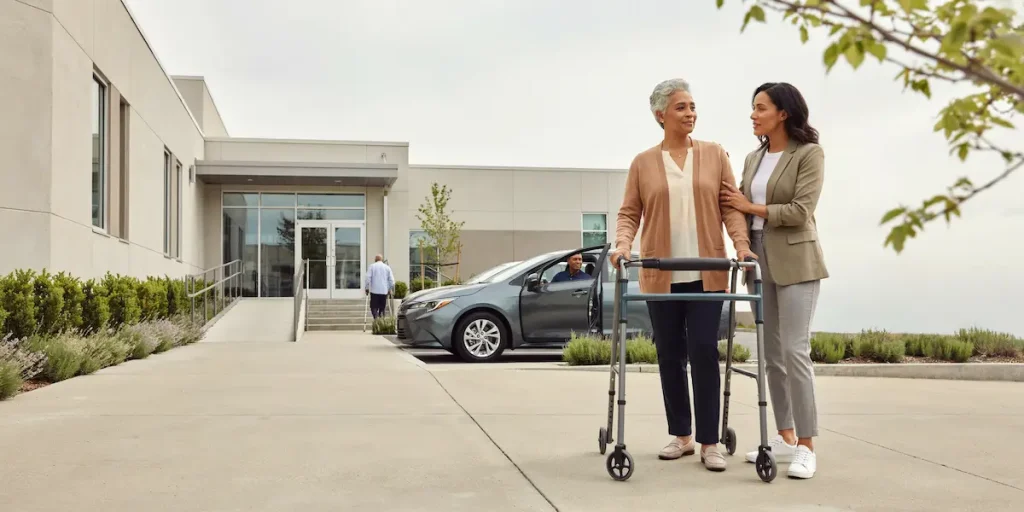
A few years ago, I got a call from a woman named Denise. Her mother had missed her cardiology appointment for the third time, not because she forgot and not because she refused to go, but because nobody could take her.
Denise had already used her paid days off that quarter. Her brother lived out of state. The local senior van needed advance notice. Someone at the cardiologist’s office had mentioned “Uber Health,” so Denise spent an hour trying to find a place to create an account.
She could not find one because, for most families, there is no individual sign-up page.
The Short Answer
Uber Health is a platform healthcare and community organizations can use to arrange and pay for transportation and certain deliveries on behalf of patients or members. A health plan, hospital, clinic, dialysis center, care organization, or another participating program typically books the trip.
Your parent generally does not need the Uber app or a smartphone when an organization arranges an Uber Health ride. Trip information can be sent by text message or communicated by phone, depending on the setup.
The important part is knowing whom to ask: start with the health plan, the medical provider’s care coordinator, or a hospital discharge planner.
Uber Health also offers organizations access to transportation and delivery options through one platform, including non-emergency medical transportation and delivery of groceries or over-the-counter items.
Why Families Cannot Usually Sign Up
Uber Health is designed for organizations, not as a direct-to-consumer transportation account that an adult child opens for a parent.
A participating organization may use Uber Health to:
- Book, schedule, and track rides for patients or members
- Cover the cost of an eligible trip
- Arrange recurring trips for ongoing care
- Coordinate deliveries of groceries or over-the-counter items
- Offer certain riders a self-booking option, when the organization enables it
Organizations that may have transportation programs include:
- Medicare Advantage and Medicaid health plans
- Hospitals and hospital discharge departments
- Primary-care offices and larger clinics
- Dialysis, infusion, radiation, and cancer-treatment centers
- Senior living communities and adult day programs
- Home-care agencies, care-management organizations, and community nonprofits
Not every organization has an Uber Health account, and an Uber Health account does not guarantee that every patient qualifies for rides. Ask whether the organization has a transportation benefit, who qualifies, what trips are covered, and how rides are scheduled.
What Happens on Ride Day
The experience depends on the transportation type your parent’s organization has arranged.
For a standard Uber Health ride, the organization books the pickup and destination. The rider or caregiver may receive trip details by text or phone, including vehicle and driver information. The organization usually pays for the ride, so the rider normally does not pay the driver directly.
But do not assume every “Uber Health ride” provides the same level of help.
Some trips may be ordinary curb-to-curb rides. Other organizations may have access to door-to-door non-emergency medical transportation or wheelchair transportation provided by credentialed third-party drivers.
Those options are not automatically available everywhere, and organizations must meet Uber’s program requirements to use certain third-party NEMT services.
Before accepting an Uber ride, ask these questions:
- Is this a standard rideshare trip, wheelchair-accessible ride, or door-to-door NEMT service?
- Will the driver come to the entrance, or is the rider expected to meet the vehicle at the curb?
- Can the vehicle safely accommodate a walker, folding wheelchair, oxygen equipment, or other mobility device?
- May a family member, aide, or caregiver ride along?
- How is the return trip arranged if the appointment runs late?
- Who should the rider or family call if the ride does not arrive?
For third-party NEMT trips arranged through Uber Health, the organization may be able to schedule ambulatory or wheelchair door-to-door rides, but these generally need to be booked at least 24 hours in advance and by 4 p.m. local time the prior day.
The Assistance Question Matters
A transportation ride is not the same as personal care.
Do not assume a standard rideshare driver can provide a safe transfer from a wheelchair, help someone down porch stairs, manage a person who is unsteady after sedation, or supervise someone with significant cognitive impairment. Those needs require a care plan, not simply a car at the curb.
Uber’s specialty options may help in some communities:
- Uber Assist is available in selected markets and is intended for riders who may benefit from extra time, help with a cane, walker, or folding mobility device, and light assistance getting into or out of the vehicle.
- Uber WAV is a wheelchair-accessible vehicle option available in selected cities.
- Third-party NEMT arranged through Uber Health may include door-to-door ambulatory and wheelchair transportation from credentialed drivers in approved areas.
Still, none of these options should be treated as a substitute for hands-on caregiver assistance, a trained transfer professional, or a medical escort when those are needed.
If your parent cannot safely get from the front door to a vehicle, transfer into the vehicle, communicate essential information, or wait safely for the return ride, arrange for a family member, aide, or other trusted person to accompany them.
Uber Health, Regular Uber, and Uber Assist
| Service | Who books and pays? | App required? | Assistance level |
|---|---|---|---|
| Uber Health | A participating health plan, provider, or organization | Usually no for organization-booked rides | Varies by service arranged |
| Regular Uber | The rider or family member | Usually yes | Standard rideshare |
| Uber Assist | The rider or family member | Usually yes | Light assistance; availability varies |
| Uber WAV | The rider or family member, or sometimes an organization | Usually yes | Wheelchair-accessible vehicle in select cities |
| Third-party NEMT through Uber Health | A qualified participating organization | Usually no for the rider | May include door-to-door ambulatory or wheelchair service |
Uber Health is the organization-facing platform. Regular Uber is the consumer app. Uber Assist and Uber WAV are ride options that may be available in the regular Uber app, depending on location.
A Newer Option: Rider Self-Booking
In February 2026, Uber Health announced a self-booking feature that allows participating organizations to let eligible riders book their own organization-funded trips through the Uber app. The organization can establish eligibility rules, trip limits, location restrictions, and spending limits.
This may be helpful for an older adult who is comfortable using a smartphone and wants more control over scheduling.
However, it is not a universal Uber Health feature. The organization must enable it, and the rider needs access to the Uber app and the account setup required by the program. If your parent’s health plan or provider uses Uber Health, ask:
“Do you offer Uber Health rider self-booking, or do all rides have to be scheduled by your staff?”
Who Pays – and Does Medicare Cover It?
Original Medicare generally does not cover routine rides to doctor appointments, therapy, pharmacies, or other non-emergency care.
Medicare may cover ambulance transportation when it is medically necessary. In certain situations, it may also cover non-emergency ambulance transportation when a provider’s written order and Medicare’s coverage requirements are met. That is different from an ordinary rideshare or routine medical-appointment trip.
Transportation benefits are more commonly found in:
- Medicare Advantage plans
- Medicaid programs
- Dual-eligible Special Needs Plans
- Some employer or retiree health plans
- PACE programs
- Hospital and community transportation programs
In 2024, 36% of Medicare Advantage plans offered transportation benefits, while 88% of dual-eligible Special Needs Plans offered them. Coverage changes from year to year and varies widely by plan, county, eligibility category, trip purpose, and transportation vendor.
When you call the health plan, ask:
“Does this plan include non-emergency transportation? How many one-way trips are covered? What appointments qualify? How much advance notice is required? Can a caregiver ride along? Is there a wheelchair-accessible or door-to-door option?”
Remember that plans often count rides one way. If a plan covers 24 one-way rides, that may equal only 12 round trips.
Do not rely on a mid-year benefits letter to discover unused benefits. CMS temporarily paused enforcement of the Medicare Advantage requirement that plans send notices about unused supplemental benefits, although some plans may still send similar notices voluntarily.
The Calls That Can Help
Make these calls in this order.
1. Call the number on the insurance card
Ask member services:
“Does this plan include transportation for medical appointments? How many one-way trips are included? Who schedules the ride? What advance notice is required? Can a caregiver ride with her? What wheelchair or door-to-door options are available?”
Write down the representative’s name, the date, the answers, and the transportation vendor’s direct number.
2. Speak with the hospital discharge planner
Do this before discharge whenever possible.
Say:
“She has no dependable transportation home or to follow-up appointments. Is there a hospital transportation program, care-coordination service, or community referral you can arrange before discharge?”
Also confirm whether the patient can safely ride in a regular car. A person who has received sedation, has impaired vision after an eye procedure, or needs monitoring may need a responsible adult or a different form of transport.
3. Ask recurring-treatment centers
Dialysis, infusion, radiation, rehabilitation, and specialty clinics often know local transportation options because missed appointments are a common barrier to care.
Ask:
“Do you have a transportation coordinator, a standing transportation program, or a list of vendors for patients who need recurring rides?”
4. Ask for the care coordinator
At a primary-care office, ask for the care coordinator, case manager, social worker, or patient navigator, not only the front desk.
Explain the practical problem:
“She is missing medical appointments because she does not have reliable transportation.”
Then ask whether the office can connect her with a covered benefit, local NEMT provider, Area Agency on Aging resource, or caregiver-support program.
5. Contact the Eldercare Locator
The Eldercare Locator can connect families to local Area Agencies on Aging and community resources. Call 1-800-677-1116 and ask specifically about:
- Medical transportation
- Volunteer driver programs
- Paratransit
- Accessible transportation
- Caregiver respite or accompaniment services
- Senior-center transportation
When Uber Health Is Not Enough
Uber Health can solve an important transportation problem. But it may not be the right fit when a person needs more than transportation.
Consider another option when your parent:
- Needs hands-on help with transfers
- Uses a wheelchair and requires a lift-equipped vehicle or securement
- Cannot safely manage stairs, thresholds, or uneven walkways alone
- Needs continuous supervision because of confusion, wandering, or impaired judgment
- Is returning after sedation, a procedure, or a treatment that requires a responsible adult
- Cannot manage oxygen equipment or another essential medical device independently
- Cannot reliably communicate if a return ride is delayed, canceled, or changed
The return trip deserves as much planning as the ride to the appointment. Confirm who triggers it, whether it is pre-scheduled, what happens if the appointment runs late, and whom the clinic should call if your parent needs help.
If Your Parent Has Dementia
The question is not simply whether your parent can get into a car. Think through every transition: leaving home, identifying the correct vehicle, arriving at the clinic, checking in, waiting after the appointment, and returning home.
For a person with dementia who may become disoriented, cannot reliably communicate their destination, or needs supervision during transitions, plan for a family member, aide, or trusted support person to accompany them.
If a solo ride is being considered, discuss the person’s abilities honestly with the care team and have a backup plan. At minimum:
- Give the clinic a family contact number.
- Make sure the return ride process is clear.
- Place identification and emergency contact information on the person.
- Avoid late-day appointments when fatigue and confusion may be worse.
- Confirm who will meet the person at home, if needed.
What You Can Set Up Today
Even if your parent cannot access Uber Health through an organization, you can still create a safer regular Uber arrangement for everyday transportation.
Uber offers Senior accounts through Family Profiles, allowing a family organizer to provide support with rides and payment methods. Uber also offers Simple mode, which uses a more streamlined app layout with larger text and fewer decisions.
A practical setup includes:
- Save home, the clinic, pharmacy, grocery store, and close family homes as saved places.
- Use a caregiver-managed payment method if that arrangement works for your family.
- Practice with a low-stakes trip before relying on the service for a medical appointment.
- Review how to identify the correct driver and vehicle before getting in.
- Make sure the rider knows what to do if the vehicle is late or the appointment runs longer than expected.
- Use trip-sharing or ride-tracking features only with the rider’s knowledge and consent.
Uber also has a phone-booking option at 1-833-USE-UBER, or 1-833-873-8237, for riders using an SMS-capable mobile phone associated with their Uber account. Uber materials list service hours of 4 a.m. to 10 p.m. Eastern, and availability may vary by location or program.
Other Transportation Options
If Uber Health or regular rideshare is not a good match, consider:
- Volunteer-driver programs operated by faith communities or nonprofits
- ADA paratransit through the local public-transit system
- County or city senior transportation programs
- Senior-center shuttles
- Hospital or clinic transportation programs
- Medicaid non-emergency medical transportation
- Private wheelchair-van or medical-escort services
- Home-care agencies that provide transportation and accompaniment
- Friends, relatives, or paid companions who can stay during an appointment
Volunteer programs and paid companions may be especially valuable when a parent needs someone to walk with them, wait through the appointment, help with paperwork, and make sure they return safely inside the home.
Before You Make the Call
Transportation is not a small detail in aging in place. It affects whether a person can get to medical appointments, therapy, pharmacy pickups, groceries, faith services, and social activities.
If your parent has begun missing appointments, treat that as a solvable logistics issue, not a personal failure.
Start with the number on the back of the insurance card. Ask about transportation benefits, advance-booking rules, caregiver companions, accessibility, and return-trip procedures. Then match the ride option to the help your parent actually needs.