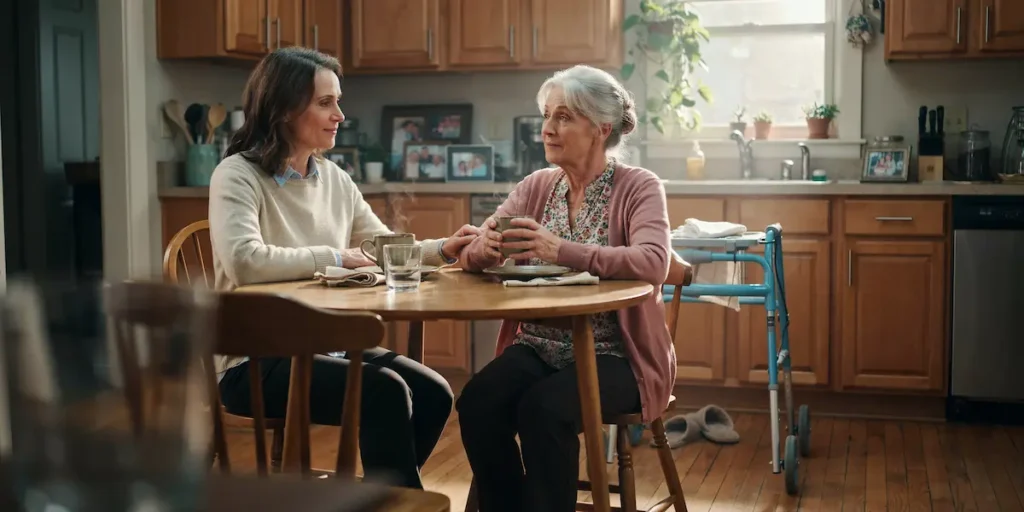
You bought the walker. Or maybe the hospital sent it home after the fall last spring. Now it sits folded in the hallway with her purse hanging on it. Meanwhile, you watch your mom cross the kitchen by grabbing the counter, then the back of a chair, then the door frame, like a swimmer reaching for the side of the pool.
You’ve asked nicely. You’ve asked not so nicely. You’ve repeated what the doctor said. She tells you she’s fine, or that she’ll use it “when she really needs it,” or she changes the subject. And every time your phone rings at an odd hour, your stomach drops.
If this sounds familiar, I want you to know two things. First, you are far from alone. In my years as an occupational therapist, I watched many walkers go home from the hospital and become coat racks. Second, your parent is almost never refusing just to be difficult.
The refusal is usually telling you something. Once you figure out what that is, you can stop having the same argument and start solving the real problem.
When an elderly parent refuses to use a walker, the reason usually falls into one of four areas: how the walker makes them feel about themselves, how it feels in their body, how well it works in their home, or changes in memory and thinking. Repeating the warning rarely changes anything, but finding the real reason almost always points you to a solution your parent can accept.
The Walker Means Something Different to Your Parent Than It Does to You
When you look at the walker, you see safety. When your parent looks at it, they may see the end of being the capable one.
I once worked with a retired schoolteacher who used her walker perfectly in the rehab gym. She agreed with every word I said. When I made my home visit two weeks later, I found the walker in the garage. She told me the neighbors would talk. She had walked to her mailbox every morning for forty years, and she was not about to do it “like an invalid.”
She wasn’t being foolish. She was protecting her sense of who she was.
Pride and the fear of losing independence are the most common reasons older adults refuse a walker. For many people, the walker feels like the first domino. If I use the walker, they’ll take my car keys. If they take my keys, they’ll say I can’t live alone. Your parent may not say any of this out loud, but it is often sitting right under the “I’m fine.”
This is why fall statistics rarely work. You are answering a feeling with a fact. Your parent already knows falls are dangerous. What they need to hear is that you understand what the walker means to them.
Try saying the feeling out loud, gently. Something like, “I wonder if the walker makes you feel like people see you differently.” You may get a sharp answer. You may also get the first honest conversation you’ve had about it.
It also helps to reframe what the walker is for. A walker doesn’t take independence away. A broken hip does. Many of the older adults I worked with started to see the walker differently once they understood it as the thing that keeps them living in their own home.
Sometimes the Walker Is the Problem
Here is something families rarely hear: sometimes your parent is right. The walker really does feel wrong, and they can’t explain why.
It Was Never Fitted Properly
Walkers handed out at hospital discharge or ordered online are often set at the wrong height. Nobody adjusts them, and your parent assumes this is just how walkers feel.
You can check the height at home. Have your parent stand tall inside the walker with their arms hanging loose at their sides. The handgrips should line up with the crease of their wrist. When they hold the grips, their elbows should bend just slightly, about 20 degrees.
A walker that is too low makes your parent hunch forward. Their weight shifts over their toes, their back starts to ache, and they are actually more likely to tip forward. A walker that is too high makes their shoulders hike up and their arms tire quickly. It feels like pushing a grocery cart uphill.
While you’re checking, make sure all four legs are set to the same hole. I have seen more than one walker with one leg a notch shorter than the others. That walker will rock with every step, and your parent will quietly stop trusting it.
It’s the Wrong Type for How They Move
Not all walkers work the same way, and the wrong type can make walking harder instead of easier.
A standard walker with no wheels is very stable, but your parent has to lift it with every step. For someone with arthritic hands, weak shoulders, or poor endurance, that gets exhausting fast. A two-wheeled walker glides in front and is a good middle ground for many people.
A four-wheeled rollator has hand brakes and a seat, which is wonderful for longer walks. It also rolls more freely, and your parent must remember to lock the brakes before sitting down.
If you’re unsure whether a walker is even the right device, this guide on how to choose between a cane or a walker walks you through how steadiness, balance, and strength affect the choice.
A walker that is the wrong height or the wrong type can feel less safe than walking without one, and your parent may be right about that.
No One Taught Them to Use It
In the hospital, walker training often lasts about two minutes. Your parent was likely tired, in pain, and ready to go home. That is not the moment anyone learns a new skill.
Without real training, people make small mistakes that make the walker feel shaky. They push it too far ahead and then lunge to catch up. They pull up on the walker to stand, which makes it tip. They turn by twisting their body instead of taking small steps around. Each mistake leads to the same conclusion: “This thing is going to make me fall.”
If your parent uses a wheeled walker, this guide on how to use a walker with wheels safely covers the basics, including the right way to sit down and stand up.
The House May Be Fighting Against the Walker
As a Certified Aging In Place Specialist, I can tell you that many walker refusals are really house problems.
Many walkers are about two feet wide. Many older bathroom doors are barely wider than that. Add a throw rug, a raised threshold, a hallway with a bookcase in it, and a bedroom where the path to the bathroom winds around a dresser, and the walker becomes something your parent has to wrestle through the house.
So they leave it behind and walk the way the house invites them to walk, from handhold to handhold. When I see an older adult “furniture walking,” it tells me the home is set up for hands, not for a walker.
Here is an exercise I ask families to do. Take the walker and follow your parent’s real routes yourself.
Go from the bed to the bathroom with the lights off, the way your mom does at 2 a.m. Go from the recliner to the kitchen. Go from the kitchen to the back door.
Notice every spot where you have to lift the walker, turn it sideways, or squeeze past something. Those are the exact spots where your parent gives up on it.
You may also notice that your parent uses the walker at the grocery store but not at home. Home feels safe because it’s familiar. But home is where most older adults fall, often in the bathroom or on the way there at night.
A professional can spot problems you might walk right past. If you’re wondering whether it’s worth it, here is a clear explanation of what happens during a home safety assessment and who can do one.
When Memory Changes Are Part of the Picture
My training as a Certified Dementia Specialist changes the whole conversation here. A person living with dementia may not be refusing the walker at all. They may simply forget it exists.
Walking without help is a lifelong habit. It is stored deep in the part of memory that handles automatic movements, the same part that lets you tie your shoes without thinking. Using a walker is a new habit.
Learning a new habit takes the kind of memory that dementia damages first. So when your dad stands up from his chair, his body does what it has done for eighty years. It walks away without the walker.
I call this the “parked walker” pattern. The walker ends up across the room, next to the bed, or in the hallway, and your parent gets up and goes without it. Reminding them later doesn’t help, because the moment has already passed.
For a parent with dementia, forgetting the walker is usually a memory problem, not a choice, so a smart home setup and gentle cues work better than persuasion.
What works is making the walker impossible to miss at the moment of standing. Place it directly in front of their favorite chair, open side facing them, every single time they sit down. Consider a second walker so one always lives by the bed and one by the recliner.
Bright colored tape on the handles can help it stand out. When your parent starts to rise, hand them the walker and say, “Here you go,” instead of “You forgot again.”
Also think carefully about the type. A rollator with hand brakes asks a person with dementia to remember several steps. A two-wheeled walker is often simpler and safer.
One more clinical note. If your parent with dementia suddenly stops using a walker they used well last month, or starts walking very differently, call their doctor. A sudden change can signal new pain, a vision problem, a medication issue, or an infection such as a urinary tract infection.
You can find more ideas in this article on helping a loved one with dementia avoid falls.
How to Find Out What’s Really Going On
Before you have another conversation, spend a day or two simply watching.
- Where does the walker get left behind?
- Is it every trip to the bathroom?
- Only at night?
- Only when company comes over?
- Only when your mom is carrying something?
The pattern usually points straight at the reason.
That last one is more common than you might think. A walker takes both hands. If your mother wants to carry her coffee from the kitchen to her chair, the walker is in her way. A simple walker tray or basket has solved more “refusals” than any lecture I ever gave.
When you do talk, trade “You have to use it” for honest questions:
- “What don’t you like about it?”
- “Where does it get in your way?”
- “Does it hurt your hands or your back?”
- “What would make it easier to use?”
As you listen, sort the answer in your head. Is this about feelings, about their body, about the house, or about memory? Each one has a different fix.
Pick your moment, too. Right after a near fall, everyone is scared and defensive. In front of grandchildren or friends, your parent will dig in to save face. A quiet cup of coffee at the kitchen table works better.
Finally, let someone else deliver the message. Parents and adult children carry decades of history. When you tell your dad to use the walker, he may hear his child bossing him around.
When a physical therapist says the same thing, he hears an expert. Families tell me all the time that their parent ignored them for months and then agreed the day the therapist said the exact same words. That isn’t your failure. It is just how families work.
Getting the Right Help (and the Right Walker)
Ask your parent’s doctor for a referral to physical therapy or occupational therapy. If possible, ask for therapy in the home, because a therapist who sees your parent’s actual hallways and bathroom can fix problems a clinic never sees. Ask the therapist to check the walker fit, teach safe walker use in the home, and suggest changes to the setup of each room.
If the current walker is the wrong type, cost doesn’t have to stop you. Medicare Part B covers walkers, including rollators, as durable medical equipment when they are medically necessary and a doctor or other treating provider prescribes them for use in the home.
After the Part B deductible, you typically pay 20% of the Medicare-approved amount if the supplier accepts assignment.
There are also middle-ground options worth talking over with the therapist:
- A rollator with a seat for someone who tires easily and wants to keep walking outdoors
- A second walker for the upstairs or the bedroom, so there is no carrying it between floors
- A basket, tray, or cup holder so your parent can carry things safely
- A cane for short, specific tasks, but only if the therapist agrees it is safe
And give your parent real choices. Let them pick the color, the style, and the accessories. A walker they chose feels like theirs. A walker that showed up from the hospital feels like a sentence.
When Your Parent Still Says No
Sometimes you do everything right, and your parent still refuses. This is the hardest part, and I want to be honest with you about it.
If your parent can make their own decisions, you cannot force them to use a walker, but you can reduce their risk and keep the door open. In caregiving we call this “dignity of risk.” It means adults have the right to make choices that others think are unwise, as long as they understand the risks.
That doesn’t mean you do nothing.
- You can make the home safer by clearing paths, adding grab bars, and improving lighting.
- You can set up a medical alert device with fall detection.
- You can agree on a daily check-in call.
- You can also negotiate small wins, like using the walker at night, in the bathroom, or outside.
A walker used for the riskiest trips is far better than a walker never used at all.
If you truly question whether your parent understands the risks, because of dementia or other changes in thinking, talk with their doctor. A doctor can help assess decision-making ability, and that answer changes how much say you have.
You’re Not Failing Them
If you’ve been losing sleep over that folded walker in the hallway, please hear this. Your worry comes from love, and your parent’s refusal is not a rejection of you. It is a person trying to hold on to their home, their dignity, and their sense of who they are.
Your goal isn’t to win the argument. Your goal is to understand what the walker means to them, fix what can be fixed, and stay close while you do it.
Some days that looks like a new walker set at the right height. Some days it looks like a rug rolled up and put away. Some days it looks like your mom using her walker only on the way to the bathroom at night, and that counts.
Small wins add up. Keep going.
This article is for general information and is not medical advice. Please talk with your parent’s doctor or a licensed therapist about their specific situation.