Outdoor lighting is used for both home security and to help keep someone (especially an older person) from tripping and falling and possibly injuring themselves.
It’s no secret that older adults simply need more light than their younger counterparts.
As you age, you need more light to see as well as you used to. Brighter lights in your work area or next to your reading chair will help make reading and other close-up tasks easier.
American Optometric Association
The need for more lighting is true indoors as well as outdoors – but oftentimes – many seniors who are aging in place neglect to optimize their outdoor lighting for a variety of reasons.
- it’s too costly
- they don’t go out as much anyway so why bother
The bottom line is that by avoiding adding the extra lighting that would make an outdoor space safer – you (or a senior loved one) may end up spending months recovering from an injury (if you recover at all).
How Much Lighting Do You Need?
More than you probably think you need. The idea is that the areas you are installing lighting should be bright enough for a senior person to see as well as possible.
BUT – there are some issues to consider. Glare and Shadows.
Glare
A majority of older adults will first notice issues with glare while driving. I myself have a very difficult time driving at night due to the glare from oncoming traffic.
Glare can impede your ability to see what’s around you and as a result you could misjudge a step or bump into an object, etc.
Solution To Reduce Glare From Lighting
There are certain types of light bulbs that you can use that can help to reduce the amount of glare that it would produce.
- Frosted light bulbs can be very useful to reduce glare
- Some light bulbs have anti-glare coatings
- Dimmable lights are also another solution
- Covers on lights to help avoid directly looking at the light bulb
- Solar lights tend to provide a softer light that may be suitable for some older adults
Shadows
Another factor to consider when installing lighting outdoors are the shadows that it produces. For seniors with dementia or Alzheimer’s – visual perception issues can cause some problems, especially with shadows.
I remember a patient of mine who would not, no matter what, step on a shadow on the floor. To him, it simply looked like a hole and as a result, he would go all the way around it.
This would not normally be a problem if the area around the shadow is flat but if outdoors there tend to be steps or grass or gravel, etc. So walking around a perceived hole can turn into a situation where the person falls and gets injured.
Solution To Dealing With Shadows From Lighting
Lots of lighting will certainly help to reduce shadows that are created by a single light. So placing lights to the right, to the left, in front and in back will all work to reduce most if not all shadows on the ground.
Where To Place Lights Outdoors?
The best places to install outdoor lighting is along every walkway, staircase and living space that you would use during the evening hours.
So, this would include areas such as…
- doorways
- driveways
- mailbox
- walkways
- steps
- railings
- patios and decks
- backyard
What Types Of Lights?
The best types of lights will depend on the location of where that light will be installed. For example, a motion sensor light is best used on driveways and the corners of houses for security reasons as well as for lighting.
So let’s go over some of the types of lights that can be used and where the best places would be to use them.
1. Motion Sensor Lights
I love motion sensor lights because they are not ON at all times which is great!
The best places to put motion sensor lights are…
- doorways
- driveways
- the corners of your house
You can install motion sensor lights that are hardwired and powered by electricity or solar lights that require no wiring. Here are some to consider.
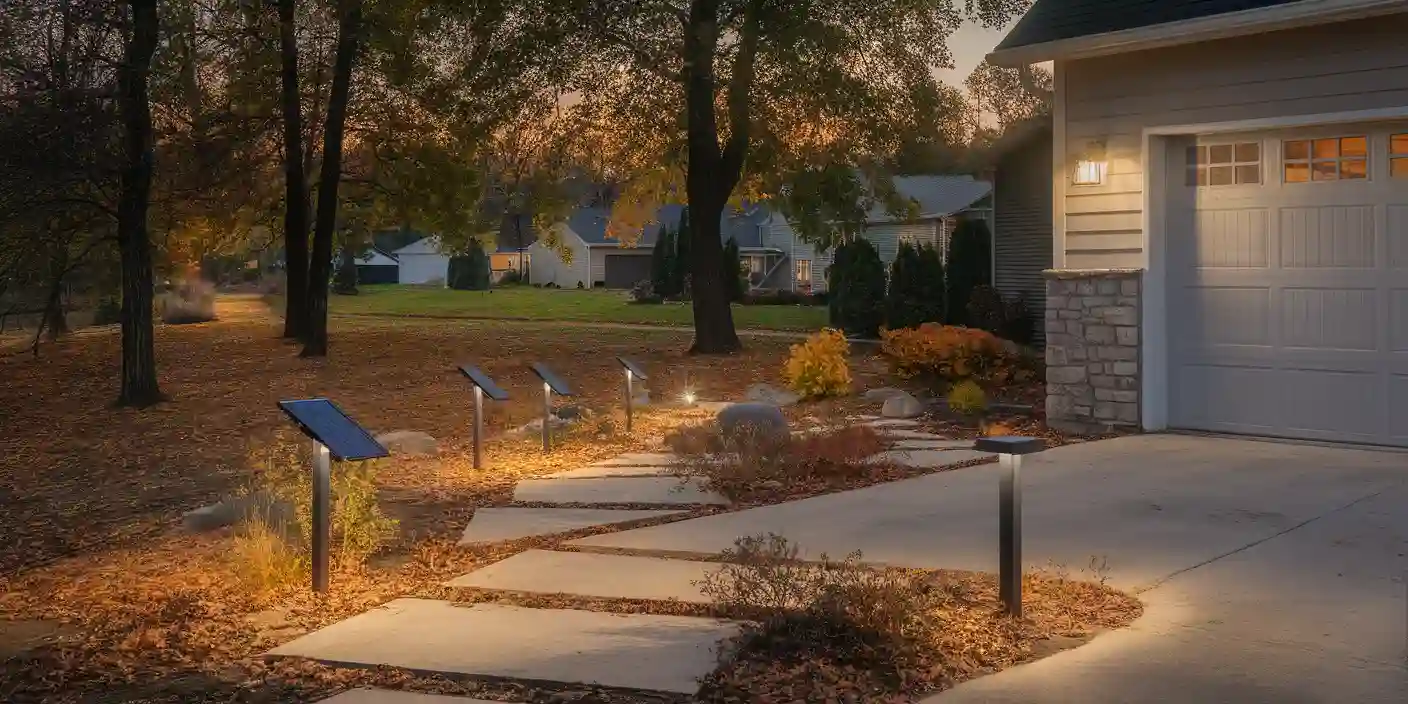
2. Path Lights

These types of lights, whether they are hardwired or solar – are meant to light a driveway or pathway to illuminate the area to make it safe to walk on.
These lights can be placed on or close to the ground so that they are low – but they can also be placed a bit higher such as on a shepherd hook.
I would however warn against placing them too high.
You do not want the glare of the light to impede yourself or a senior loved one’s vision.
Again, you can install electric lights or solar lights – whatever fits your fancy.
3. Step Lights
Adding lights to steps is very important (especially for older adults). The reason is that a person’s visual perception normally declines as they get older and as a result they have difficulty identifying a change in the path.
In other words, they may not be able to “see” that there is a step there and they may end up losing their balance and falling.
What Height Do You Hang Outdoor Lights?
Traditionally, outdoor lights should be hung about 66 to 72 inches above the ground. Of course – this is so that the light is above the person.
The most important factor I would recommend you to consider when installing lights outdoors for a home with senior citizens is to consider the brightness and glare that the light may produce.
For some older adults, it may be better to hang a light lower than their eye level so as to avoid direct contact with the light.
Naturally, a light over a doorway would be important and for these instances I would recommend a soft focused light to again avoid a glaring bright light.
But, as I’ve mentioned earlier, when it comes to adding lights to walkways outdoors, having lights below eye level would work very well.