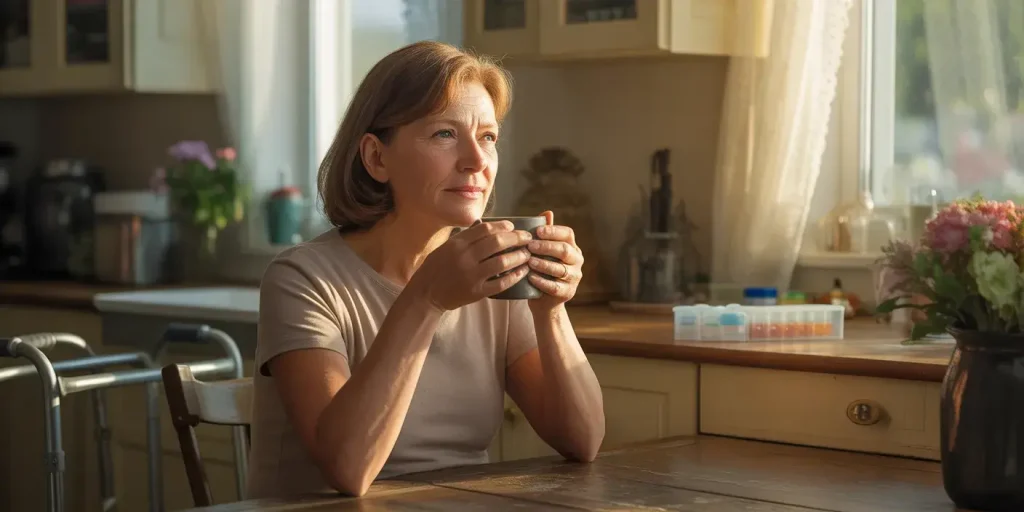
If you are reading this, there is a good chance you already know what caregiver isolation feels like. Maybe you used to have lunch with friends on Thursdays. Maybe you had a standing phone call with your sister every Sunday.
Maybe you had a life that felt like yours. And somewhere in the process of showing up for someone you love, piece by piece, that life quietly got smaller.
You did not set out to become isolated. No one does. But caregiving has a way of filling every available hour, every spare thought, and every ounce of energy you have. And when it does, the things that once connected you to other people are usually the first to go.
What I want you to know before we go any further is this: what you are feeling is not a sign that you are doing something wrong. It is a predictable outcome of an incredibly demanding role.
And there are real, practical ways to change it, even when your time and energy are already stretched thin.
Throughout this article, each section ends with a specific action you can take, and at the end I have pulled everything together into a simple step-by-step plan you can start using today.
Caregivers feel isolated because the relentless demands of caregiving gradually crowd out the friendships, activities, and personal routines that once kept them socially connected, and because the emotional weight of the role can feel impossible to explain to anyone who has not lived it.
The most effective way to address caregiver isolation is to build a realistic support network around your caregiving life, not the life you had before, by mapping your existing connections, creating a simple daily check-in habit, finding one consistent activity outside the home, and joining a caregiver support group where people understand without explanation.
Why Caregiver Isolation Is So Common
I want to say this clearly, because I have seen how much caregivers blame themselves: isolation is not a character flaw. It is not evidence that you are antisocial, ungrateful, or failing the person you care for. It is a predictable, well-documented outcome of taking on one of the most demanding roles a human being can hold.
Research consistently shows that family caregivers are at significantly higher risk for loneliness than non-caregivers, even when their overall social network size is similar. That finding is striking. It tells us that the problem is not simply about how many people a caregiver knows.
It is about the quality of connection, the sense of being truly understood, and the lived experience of feeling like no one around you really gets what you are carrying.
In my years working as an occupational therapist and now as a Certified Aging in Place Specialist, I have sat with hundreds of family caregivers. Almost all of them told me some version of the same thing: they did not realize how alone they had become until something forced them to stop and look around.
| DO THIS NOW |
| Take two minutes right now and ask yourself honestly: when did I last spend time with someone who had nothing to do with caregiving? If you cannot remember, that is your starting point. Write down one name, one person you have been meaning to call. That name is your first action. You do not need to call today. Just write the name down. That small act makes the intention real. |
Grab The Full Workbook!

The Slow Disappearing Act
Caregiver isolation rarely happens all at once. It happens the way a tide goes out: gradually, almost imperceptibly, until one day you look up and the shoreline has completely changed.
It usually starts with small cancellations. You skip a dinner because your loved one had a hard day. You miss a walk because the morning routine ran long.
You tell yourself you will reschedule, and you mean it. But the reschedule never happens, and eventually people stop asking. Not because they stopped caring, but because life moves on and they assume you are managing.
Over time, the social calendar empties out. Hobbies get shelved. Phone calls get shorter and further apart.
You find yourself turning down invitations not because you do not want to go, but because the logistics of leaving feel overwhelming, and the guilt of stepping away feels heavier than the loneliness itself.
When You Are Physically Present but Emotionally Invisible
There is a particular kind of loneliness that many caregivers describe that goes beyond simply being alone. It is the loneliness of being surrounded by people, including family members, neighbors, and even the person you care for, and still feeling completely unseen.
Part of this comes from the nature of the role. Caregiving asks you to focus outward, constantly. Your attention, your planning, your emotional energy are all directed toward someone else’s needs. There is often very little space left to articulate your own.
And even when you try to share what you are going through with people outside the situation, it can feel like you are speaking a language they do not quite understand.
The exhaustion, the grief, the complicated love, the guilt, the moments of frustration followed by shame: these are hard to describe to someone who has not been there.
That gap between your inner experience and what feels expressible to others is one of the loneliest places a caregiver can find themselves.
| DO THIS NOW |
| The next time someone asks “How are you?” try answering honestly, even just a little. Instead of “Fine,” try: “Honestly, it has been a hard week. I am tired more than I expected to be.” You do not have to say everything. But letting one person see even a small part of what you are carrying is the beginning of real connection, and it is a skill worth practicing. |
Why Asking for Help Feels So Hard
Here is something I have noticed consistently over the years: caregivers are often the last people to ask for help. Even when they are drowning.
Some of it is guilt. If I am out with friends, who is watching Mom? If I take time for myself, does that mean I am not devoted enough? The belief that good caregivers put themselves last runs deep, and it is reinforced by a culture that tends to romanticize self-sacrifice without acknowledging the damage it causes.
Some of it is pride. Many caregivers have built their identity around being capable, reliable, and strong. Reaching out feels like admitting defeat, or worse, like complaining about a role they chose.
And some of it is something I see less often discussed: fear. Fear that if they start talking about how hard it really is, they will fall apart. Fear that if they let themselves feel the loneliness fully, they will not be able to get back up.
What I want to say to that fear is this: reaching out is not falling apart. It is the thing that keeps you from falling apart. The caregivers I have seen sustain themselves over the long haul are almost always the ones who figured out, often reluctantly, how to let other people in.
| DO THIS NOW |
| Write down one specific thing someone else could do to help you this week. Not a vague wish, a concrete task. Pick up a prescription. Sit with your loved one for two hours on Saturday. Bring a meal on Thursday. Then identify one person who could realistically do that thing. Send them a message today. Use this script if it helps: “I have been hesitant to ask, but I could really use some help with [specific task]. Would you be able to help this week?” Most people want to help and simply do not know how. Giving them something specific makes it easy for them to say yes. |
What Caregiver Isolation Actually Does to Your Health
I am not going to bury this in alarming statistics, but I do want you to understand why this matters beyond how you feel day to day.
Chronic loneliness and social isolation carry real physical consequences. Research has linked prolonged isolation to increased risk of depression, anxiety, cognitive decline, and cardiovascular problems.
The health effects of long-term isolation are significant enough that researchers have compared them to other well-known health risks. That is not a small thing.
But here is what I find even more compelling for caregivers specifically: a caregiver who is isolated, depleted, and emotionally exhausted is not a better caregiver. They are a more vulnerable one.
Research is clear that caregivers who remain socially connected are more resilient, more patient, and better equipped to handle the inevitable hard moments that come with the role. Maintaining your own connections is not a luxury. It is part of how you sustain the care you give.
| DO THIS NOW |
| Check in with yourself right now using three simple questions: 1. Am I sleeping? 2. Am I eating? 3. Have I spoken to someone outside this house in the last 48 hours? If the answer to any of these is no, that is not just a wellness concern. It is a caregiving sustainability concern. Start with the easiest fix first, and treat it as seriously as you would treat your loved one’s needs. |
Building Your Support Network: Where to Start
I want to be honest with you about something before we get into practical steps. The advice you often see for caregiver isolation assumes a kind of bandwidth that most caregivers simply do not have. Join a gym. Take a class. Volunteer somewhere.
These suggestions are not wrong, but they assume you have hours and energy that may already be fully spoken for.
What I am going to offer instead are approaches that fit around your real life. Small, sustainable, and grounded in what I have seen actually work with the caregivers I have supported over the years.
Step 1: Map What You Already Have
Most caregivers assume they are starting from scratch when they actually have more connections than they realize, connections that have just gone quiet.
Grab a piece of paper and draw three circles. In the inner circle, write the names of people you would call in a genuine emergency: adult children, a sibling, a close friend, a trusted neighbor. Even one or two names belongs here.
In the middle circle, write people you see or hear from occasionally but are not deeply connected with right now: someone from your faith community, a former coworker, a neighbor you wave to.
In the outer circle, add the professionals already in your world: your loved one’s doctor, a pharmacist, a home health aide, a meal delivery driver.
Most caregivers are surprised by what ends up on the paper. The network is rarely as empty as it feels. It has often just been neglected, not abandoned. That is a much more workable starting point.
| DO THIS NOW |
| Do the three-circle exercise today. It takes less than ten minutes and it will show you exactly where to focus your energy first. Once you have your circles drawn, circle one name in the middle ring and one name in the inner ring. Those are your first two contacts. Reach out to the inner ring person this week and the middle ring person next week. |
Step 2: Strengthen What Is Already There
You do not always need new friends. You often just need stronger contact with people already in your life.
The key is consistency over intensity. A two-minute text on a Tuesday matters more than a long conversation you keep meaning to have.
A short phone call on your drive to the pharmacy counts. Relationships are built through repeated contact, not grand gestures, and that is genuinely good news for someone with a packed schedule.
| DO THIS NOW |
| Choose one person from your inner or middle circle and commit to one contact per week for the next four weeks. Set a recurring reminder on your phone right now labeled “Reach out to [name].” It can be a text, a two-minute call, or a voice memo. The content matters less than the consistency. Four weeks of small contact does more for a relationship than one long catch-up call after six months of silence. |
Step 3: Create a Neighbor Check-In Partnership
This is one of the simplest and highest-value moves I recommend to caregivers, and it costs nothing but a five-minute conversation.
Approach a neighbor you feel comfortable with and say something like this: “I am managing a lot at home right now and I would feel better knowing someone nearby had my back. Would you be open to keeping an eye on things, and I will do the same for you?”
You can exchange phone numbers, agree to notice if the other’s mail piles up, and check in after bad weather.
Most neighbors are relieved to be asked, because many of them were hoping for the same arrangement. It is practical, low-pressure, and creates a layer of connection that is genuinely comforting in the thick of caregiving.
| DO THIS NOW |
| Identify one neighbor this week. You do not need to have a long history with them. You just need to feel comfortable enough to knock on their door. Use this script: “Hi, I wanted to introduce myself properly. I am caring for my [family member] at home and I have been thinking it would be good for both of us to have a neighbor connection. Would you want to exchange numbers?” |
That is the entire conversation. Most people say yes within thirty seconds.
Step 4: Set Up a Daily Check-In System
One of the simplest and most effective habits I have seen caregivers adopt is a daily check-in with one or two trusted people. It takes less than a minute and the cumulative effect is significant.
| DO THIS NOW |
| Choose your method and set it up today: Text method: Every morning, send a single text to one person that says “Good morning, I am okay.” Ask them to follow up if they do not hear from you. Group text method: Create a small group of two or three trusted people who check in with each other daily. If someone does not respond, the others know to follow up. Phone method: Arrange a quick five-minute call with one person at the same time each day, such as during your morning coffee or your loved one’s nap time. Pick whichever method you will actually use and set it up before you finish reading this article. |
Step 5: Find One Regular Activity Outside the House
I am not going to tell you to take up a new hobby. What I am going to say is this: find one thing, any one thing, that puts you in the same room as other people on a regular basis. Consistency is what builds familiarity, and familiarity is what eventually becomes connection.
It could be a weekly faith service, a water aerobics class, a library program, or a short volunteer shift. The goal is not to make a best friend by the third week.
The goal is to become a familiar face. Familiar faces become trusted acquaintances, and trusted acquaintances become part of your support network without you having to engineer it.
| DO THIS NOW |
| Search for one of the following in your area this week: senior center programs, library events, faith community gatherings, community center classes, or local caregiver meetups. You are not committing to going forever. You are committing to going once. Put one event in your calendar right now. Arrange care coverage if needed. Treat it like a medical appointment, because for your long-term health, it is. |
Step 6: Use Technology to Close the Distance
Video calls, group texts, and online caregiver communities have changed what connection looks like for people with limited time or mobility. If you have not explored these, they are worth your attention.
FaceTime, Zoom, and Google Meet can shrink distance dramatically. Online caregiver forums and Facebook groups connect you with people who understand your situation in a way that many local friends may not.
Many libraries offer free technology training if getting started feels like a barrier.
| DO THIS NOW |
| Search “caregiver support group online” or visit the Family Caregiver Alliance at caregiver.org to find a virtual group that meets at a time that works for your schedule. If you are not comfortable with video calls yet, a text-based online forum is a perfectly valid starting point. Connection does not require a camera. |
Step 7: Build Your Help List Before You Need It
Emergencies are not the time to figure out who to call. Before you need it, create a written help list and keep copies in three places: on your refrigerator, in your wallet, and saved in your phone.
| DO THIS NOW |
| Create your help list with three sections: Medical: doctor, pharmacy, after-hours nurse line, emergency contacts Home: plumber, electrician, handyman, neighbor with a spare key Personal: three people you can call if you need backup care, emotional support, or practical help Do not wait until you need this list to make it. Make it this week and put it somewhere visible. |
Caregiver Support Groups: Why They Work When Nothing Else Seems To
I want to say something specific about caregiver support groups, because I have watched caregivers resist them for months and then come back to tell me it was the best thing they did.
The resistance is understandable. I do not have time. I am not a group person. I do not want to sit in a circle and cry. I hear these things regularly.
What I tell people is what I have seen happen, repeatedly: you go once, you sit in a room with people who understand without explanation, and something in you exhales. Not because your problems are solved, but because you are no longer holding them entirely alone.
The specific relief of being understood by someone who has lived something similar to what you are living is different from any other kind of support. It does not replace friends or family. But it fills a gap that nothing else quite fills.
Support groups are available in-person through hospitals, hospices, faith communities, and senior centers. Many are also available online, which removes the barrier of leaving the house entirely.
| DO THIS NOW |
| Find a support group this week using one of these resources: caregiver.org (Family Caregiver Alliance): searchable database of local and online groups Your loved one’s physician or specialist: ask directly at the next appointment Your local Area Agency on Aging: search “area agency on aging” plus your city or zip code Eldercare Locator: eldercare.acl.gov or call 1-800-677-1116 Commit to attending once. You can decide after that first meeting whether it is right for you. Most people who go once go back. |
For more on what caregivers need most beyond connection, see our article What Caregivers Need Most, which covers emotional support, practical tools, and where to find professional guidance.
Your Caregiver Isolation Action Plan
Everything covered above comes together here. This is your step-by-step plan, ordered by what to do first. You do not need to complete all of it this week. Start at Step 1 and move through it at your own pace.
1. Do the three-circle exercise.
Grab paper and map your inner circle (emergency contacts), middle circle (occasional connections), and outer circle (professionals). Identify your first two contacts.
2. Reach out to one person from your inner circle this week.
A text, a call, a voice memo. Keep it short. The goal is contact, not a full catch-up. Set a recurring weekly reminder to keep doing this.
3. Knock on one neighbor’s door and propose a check-in partnership.
Use the script: “I am caring for someone at home and thought it would be good to have a neighbor connection. Would you want to exchange numbers?” This takes five minutes and pays off for months.
4. Set up your daily check-in system today.
Choose text, group text, or phone call. Identify your person or group. Set it up before you go to bed tonight. Put a recurring alarm on your phone if it helps.
5. Ask one person for one specific thing this week.
Pick up a prescription. Sit with your loved one for two hours. Bring dinner on Friday. Make the request concrete and give them an easy way to say yes.
6. Find one regular activity and put it in your calendar.
Search for a local senior center program, library event, or faith community gathering. Commit to going once. Arrange care coverage and treat it like an appointment.
7. Search for a caregiver support group.
Use caregiver.org, your loved one’s doctor, or your local Area Agency on Aging. Look for an online option if leaving the house is the barrier. Commit to attending once.
8. Build your help list.
Write down your medical, home, and personal contacts. Keep a copy on the refrigerator, in your wallet, and in your phone. Do this before you need it.
9. Check in with yourself weekly.
Every Sunday, ask yourself:
- Did I connect with someone this week?
- Did I sleep and eat reasonably well?
- Did I take even thirty minutes that were mine?
If the answer is no to all three, that is your signal to revisit this plan.
You Cannot Pour From an Empty Cup, and Your Loved One Needs You Full
Maintaining your own social connections is not selfish. It is not a betrayal of your caregiving role. It is one of the most responsible things you can do for the person you are caring for.
Caregivers who are isolated, emotionally depleted, and cut off from support become less effective over time. Not because they care less, but because human beings are not designed to sustain that kind of unrelenting output without replenishment.
We are wired for reciprocal connection. We need to give and receive. We need to be seen, not just needed.
When I worked with families as an occupational therapist, one of the most consistent patterns I observed was this: when the caregiver was doing better, the person being cared for was also doing better.
Better mood, better cooperation, better daily quality of life. The two are connected in ways that are hard to separate.
Getting connected is part of the job. Please give yourself permission to treat it that way.
If you are also managing caregiver burnout alongside the isolation, our article on caregiver burnout and how to reclaim your life addresses the emotional weight of the role with honesty and practical guidance.
You Deserve the Same Care You Give
Caregiving is one of the most profound things one human being can do for another. It is also one of the most isolating, and that is not something caregivers talk about enough.
You are not failing by feeling alone. You are human. The isolation you are experiencing is a side effect of a role that demands more than any one person should carry without support. Recognizing that is not weakness. It is clarity.
The steps in this article are not meant to be done all at once. They are meant to be done one at a time, in the order that makes sense for your life.
Start wherever feels most manageable. Even the smallest action, one text, one name on a piece of paper, one door you knock on, is a thread connecting you back to the world outside your caregiving role.
Those threads matter. They hold you. And a caregiver who feels held is a better caregiver, a healthier person, and someone who will be able to sustain this work for as long as it is needed.
If the loneliness feels deeper than situational isolation, our article on caregiver loneliness and how to cope goes deeper into the emotional experience and offers additional strategies for finding support.