When dementia causes gibberish speech, it happens because the disease damages brain areas that control language. This can lead to “word salad,” made-up words, or sentences that don’t make sense.
While this is common in middle and late stages of dementia, there are ways caregivers can still connect and support meaningful communication.
Quick Rundown: Dementia and Talking Gibberish What It Means and How to Respond with Care
- Why It Happens: Brain changes from dementia can disrupt language centers, causing speech to sound jumbled or nonsensical.
- Not Just Words: “Word salad” may mix real words, invented ones, or incomplete thoughts that are hard to follow.
- Look for Triggers: Fatigue, stress, or overstimulation can make communication difficulties worse.
- How to Respond: Stay calm, listen patiently, and focus on tone and body language rather than correcting words.
- Offer Comfort: Gentle reassurance, touch, or redirecting to a soothing activity can reduce frustration.
- Professional Support: Speech therapists and dementia care specialists can provide strategies to ease communication challenges.
I know how heartbreaking it feels when words begin to vanish. Families I’ve worked with often describe it as “losing the person twice”, once to the disease and again to the silence.
But I’ve also seen how small adjustments, compassionate communication, and caregiver support can restore peace and connection, even when speech no longer makes sense.
In the sections that follow, I’ll explain why dementia causes gibberish speech, what to watch for, and the strategies and tools that truly help. Let’s begin with what’s really happening in the brain.
Why is My Loved One with Dementia Speaking Gibberish?
As dementia progresses, it often affects brain areas responsible for language. This can lead to speech that sounds like gibberish, including jumbled words, made-up terms, or sentences that don’t make sense.
These symptoms aren’t intentional, they reflect how dementia affects speech centers in the brain, like Wernicke’s and Broca’s areas.
Understanding What’s Happening in the Brain
Key brain areas involved in language:
- Wernicke’s area – creates fluent, meaningful sentences
- Broca’s area – helps form speech and grammar
- Semantic memory systems – store meanings of words
When these areas decline, you may hear:
- Word salad – real words strung together without meaning
- Jargon aphasia – fluent speech using neologisms (made-up words)
- Word-finding difficulty – long pauses or wrong words
❓Can people with dementia tell that they’re speaking nonsense?
💬 Sometimes, especially in the early stages. They may feel embarrassed, frustrated, or try to “cover” their confusion. In later stages, awareness fades, but emotional signals, like anxiety or sadness, may still show. Responding with kindness and nonverbal reassurance can calm both of you.
When Dementia Speech Changes Signal a Medical Emergency
Call a doctor or 911 if your loved one suddenly begins:
- Speaking incoherently all at once
- Slurring their words
- Showing weakness on one side of their body
- Acting very sleepy, confused, or “off”
These could be signs of:
- Stroke
- UTI or infection
- Medication side effects
- Delirium
Dementia language loss is usually gradual. Sudden changes mean something else may be wrong.
What Are the Different Types of Aphasia in Dementia?
| Aphasia Type | What It Looks or Sounds Like |
|---|---|
| Wernicke’s aphasia | Fluent but meaningless speech |
| Broca’s aphasia | Broken, slow, or halted sentences |
| Semantic dementia | Trouble remembering word meanings |
| Primary progressive aphasia (PPA) | Gradual, worsening language loss |
| Jargon aphasia | Confusing but fluent speech with made-up words |
Each type affects communication in unique ways. Your loved one may mix words, invent new ones, or lose the ability to name objects.
❓Does everyone with dementia lose the ability to speak?
💬 Not everyone. Some people maintain short, clear sentences into the later stages. Others, especially those with PPA, may lose speech early. While words may fade, emotions and connection still remain.
Practical Communication Tips That Really Work
Here’s how to talk with someone whose words no longer make sense:
✅ Use short, simple sentences
✅ Speak slowly, calmly, and clearly
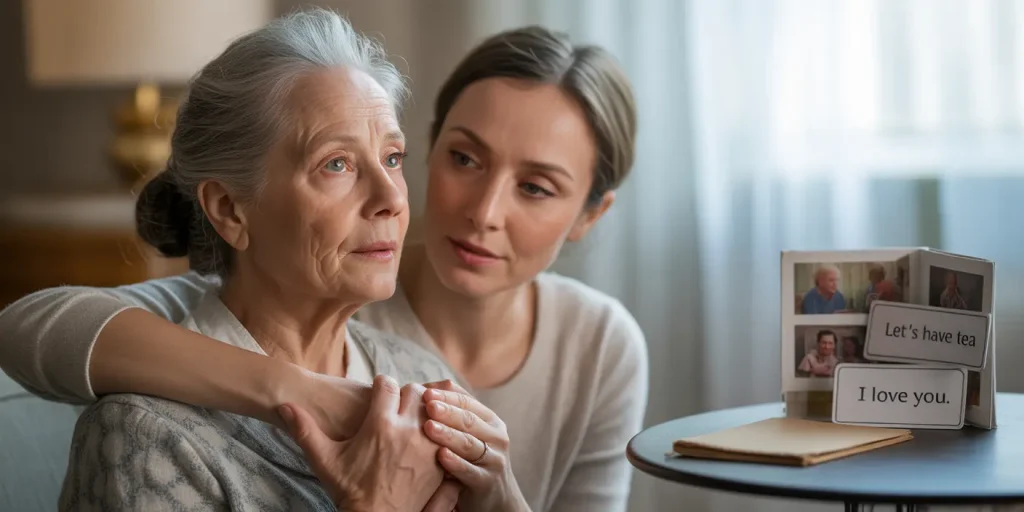
✅ Point to objects or use pictures
✅ Avoid correcting or arguing
✅ Focus on emotion, not exact words
✅ Smile, use eye contact, and offer comfort
✅ Use yes/no questions instead of open-ended ones
Example: Instead of, “What do you want for lunch?”
Try: “Do you want soup? Yes or no?” (Then show the soup!)
❓What should I do if my loved one gets upset when I don’t understand them?
💬 Stay calm and gentle. Use soft body language and phrases like, “It’s okay, I’m here with you.” Avoid correcting them or pressing for answers. In these moments, your support matters more than the words.
Helpful Tools You Can Use at Home
Communication products can help when words get jumbled:
- Picture Communication Board – with large icons for basic needs
- 6-Pack Communication Boards – themed boards for everyday use
- Caregiver Cue Cards – yes/no, needs, feelings
- Music therapy playlists on Alexa or Spotify – use familiar songs to trigger positive responses
Also ask your doctor for a speech-language therapy referral. Therapists can recommend tools and strategies matched to your loved one’s abilities.
❓Will speech therapy help even in late-stage dementia?
💬 Yes. Speech therapy can’t reverse dementia, but it can slow loss and teach helpful routines. Therapists offer training for caregivers, suggest AAC tools, and help preserve communication for as long as possible.
What Language Changes Look Like Over Time
Early Stage
- Word-finding trouble
- Repeating words or phrases
- Misnaming objects
Middle Stage
- Jargon aphasia
- Broken or out-of-order sentences
- Confusion in conversations
Late Stage
- Short words or sounds
- Mumbling or silence
- Nonverbal communication only
Even in silence, people with dementia can respond to tone, facial expressions, and gentle touch.
Want to Know What Stage This Behavior Might Represent?
If your loved one has started speaking gibberish or using made-up words, you might wonder what stage of dementia this reflects. Speech changes like this typically appear in the middle to later stages, which you can track using the FAST Scale (Functional Assessment Staging Tool).
The Emotional Side You Don’t Hear Enough About
I’ve watched so many families struggle when their loved one’s words disappear.
It’s not just speech loss, it’s a quiet kind of grief. You’re not only missing conversations. You’re grieving the person you used to talk with, laugh with, and feel known by.
You may feel:
- Frustrated or overwhelmed
- Sad or angry
- Like you’re watching someone disappear in slow motion
- Helpless when you can’t “fix” what’s happening
And yet, here you are, still showing up. That’s love in action.
What You Can Do to Care for Your Heart While You Care for Theirs
Acknowledge your feelings without guilt.
It’s okay to grieve someone while they’re still here. You can love them deeply and still feel exhausted, heartbroken, or confused.
Create quiet moments just for you.
Even 10 minutes a day can help. Listen to music, sit outside, write in a journal. Give your nervous system a break.
Talk to someone who gets it.
Join a dementia caregiver support group (online or in person). You’ll feel less alone, and you’ll learn from others walking the same path.
Capture small wins.
Keep a little notebook or phone note with moments that went well. A smile, a hand squeeze, a shared laugh, these are victories.
Let others help.
Don’t carry this all by yourself. Ask a friend to visit, get help from home health aides, or bring in a professional to guide you.
Focus on emotional connection, not conversation.
Even if the words are gone, your presence matters. A gentle tone, eye contact, soft music, or a loving touch can say more than language ever could.
Remember: You’re still a part of their story.
Even if they can’t say your name, they may still know your spirit. They may feel your love in ways that words can’t explain.
❓How can I explain this to children or other family members?
💬 Try saying, “Grandpa’s brain is sick and sometimes his words don’t work right.” Reassure them that it’s not their fault. Let them help by offering a smile or singing together. Involve them in small, loving moments.
You’re Still the Hero in This Story
You might not understand every word, but your love still speaks volumes.
You are their calm voice. Their anchor. Their heart connection.
And that’s what matters most.
Final Thoughts: Holding On to What Still Matters
Even when speech sounds like nonsense, your care is never wasted.
Whether they say “grapple flap lampy” or nothing at all, your presence, your tone, and your love still reach them.
So keep showing up. Keep loving.
Because you are making a difference.