You are flipping through a catalog, maybe for your mom, maybe for yourself, and you land on a white plastic grab bar. Your stomach drops a little. You close the catalog and think, “That is not going in my bathroom.”
If you have felt that, you are in good company. I spent years as an occupational therapist working with older adults, and I can tell you what is really happening in that moment. You are not saying no to safety. You are saying no to the label that comes with it.
I watched many people turn down equipment that looked medical, then grab a towel bar when their balance slipped. Towel bars are not built for that. Some of those people fell in the one room of the house that gave them the fewest good options.
The good news is that you no longer have to choose between a beautiful bathroom and a safe one. The best products today look like they belong in a boutique hotel, and they work as well as the clinical ones.
The key is choosing the right pieces, getting them installed correctly, and thinking of them as part of your home’s design. Here is how I approach it as a Certified Aging In Place Specialist and Certified Dementia Specialist.
The Short Answer
The safest bathroom upgrades that don’t look medical are designer grab bars anchored into solid wall framing, a teak shower bench, a handheld shower on a slide bar, and matte, slip-resistant flooring with a proper wet rating. Each one blends into the room when you choose a finish that matches your fixtures, and each one works only if it is installed correctly. You can keep the look you love and still have something steady to hold.
Why Clients Say No to “Medical” Bathrooms
Why “Medical” Bathrooms Feel Like a Loss
Your bathroom is the most private room in your home. It is where you start and end each day. Filling it with hospital-style equipment can feel like the house is no longer yours.
In my experience, the resistance usually comes from four places.
- The first is age. A white plastic bar says, “You are old now.”
- The second is independence. Many people fear that accepting equipment means a care facility is next.
- The third is pride in the home. You spent years choosing the tile and fixtures.
- The fourth is resale, because some people worry a future buyer will see a “handicapped bathroom.”
I have seen the same pattern many times. A person refuses a grab bar for months. Then they start leaning on the sink edge, the shower door, or the towel bar.
They have already decided they need support. They just do not want to say it out loud. The upgrades in this article let you get that support without giving up your style.
People resist medical-looking bathroom products because those products announce age, suggest lost independence, and make a home they love feel like a care facility.
If You Are Helping a Parent or Spouse
Pushing hard usually backfires. When someone feels cornered, they dig in. Try these approaches instead.
- Ask what bothers them about the bathroom. Maybe the tub is hard to climb into, or the floor feels slick. Start from their problem, not your worry.
- Begin with something that helps everyone, like a handheld shower. Visitors, tall people, and grandkids all benefit. It is an easy first yes.
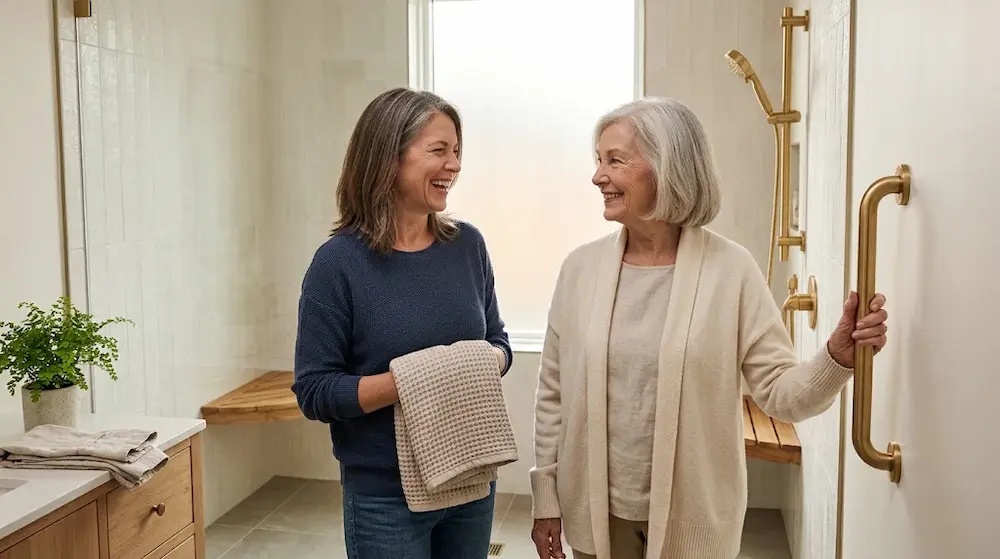
- Show finishes, not catalogs of medical gear. Hand them a sample bar in brushed brass. Let them feel how well it grips. A photo of a pretty bathroom does more than a lecture about falls. Companies like PonteGiulio and TeakCraft provide beautiful products.
- Use language that respects them. Words like comfort, ease, and “built to last” feel good. Words like “fall risk” and “for seniors” feel like a label.
Designer Grab Bars That Still Do Their Job
Grab bars are usually the biggest worry, and they are also the most important piece. The good news is that stylish ones exist in nearly every finish.
What Makes a Grab Bar Safe
A grab bar has one job: let your hand close around it and hold your weight. Four details decide whether it can.
Diameter. The ADA standard calls for a gripping surface between 1¼ and 2 inches, so your hand can wrap around it. Some very slim decorative bars are smaller than that, so check the product details.
Clearance. There should be about 1½ inches between the bar and the wall so your fingers fit behind it.
Strength. Look for a stated load rating. The ADA standard calls for a bar and its mounting to hold at least 250 pounds.
Wet grip. A lightly textured surface holds wet, soapy hands better than a mirror-polished one.
Most shower bars sit between 33 and 36 inches off the floor. The best height depends on the person, so have a professional adjust it for the one who will use it.
Yes, designer grab bars can be just as safe as medical ones, but you need to check the diameter, wall clearance, and load rating, because a beautiful finish does not guarantee a strong bar.
Why Installation Matters More Than Style
A bar is only as strong as what holds it to the wall. I have seen gorgeous bars held on by small screws into tile and hollow wall. That is worse than no bar at all, because it gives you false confidence. You trust it with your full weight at the exact moment it matters most.
A bar needs to be anchored into solid wood framing or blocking behind the wall. If the framing is not in the right spot, a skilled installer can use specialty anchors made for grab bars. Standard drywall anchors are not enough. This is a job for a professional, not a weekend DIY project.
After the bar goes in, test it. Grab the middle and pull firmly in several directions. Any wiggle at all means it needs to be fixed.
Matching Your Finishes
Matte black, brushed brass, polished nickel, and brushed nickel grab bars are all easy to find. Many well-known fixture lines sell grab bars in the same finish as their faucets. Match them, and the bar blends into the design.
Dual-purpose bars work well if you worry about the look. Some hold towels, some include a shelf, and some wrap around the shower valve. Here is the catch. A towel bar sold as a towel bar is not a grab bar. Only use a dual-purpose piece that is labeled, rated, and installed as a grab bar.
If You Are Remodeling
Ask your contractor to add solid blocking (2×8 or 2×10 lumber or plywood between the studs) around the shower, beside the toilet, and along the tub wall while the walls are open. It costs very little then.
It costs a lot to open the walls again later. Ask for photos of the blocking with a tape measure in the frame before the drywall goes up. Blocking also lets you say “not yet” today and “yes” in five years without any demolition.
You can find a list of contractors that can help with Grab Bar Installations here.
Teak Benches and Shower Seating That Look Like Spa Furniture
Seating is the upgrade I wish more people accepted. A seat is not just for people who cannot stand. A hot shower can make anyone light-headed, because heat opens blood vessels and blood pressure can drop.
Washing and drying your feet while balanced on one leg is one of the riskiest things I see people do in a bathroom. A bench takes both problems away.
Teak is the material that makes a seat look like furniture. It is a dense hardwood with natural oils, so it resists water and rot.
A slatted top lets water drain, so the seat does not stay wet and slick. Choose stainless steel hardware, and check the weight rating to be sure it fits the person who will use it.
You have three main choices:
- Freestanding bench: Easy to set up and easy to move. Look for adjustable rubber feet so it sits level.
- Wall-mounted folding seat: Folds flat when not in use, which suits a small shower. It must be anchored into blocking or studs and rated for the load. The ADA standard puts the seat height at about 17 to 19 inches.
- Built-in corner bench: The most luxurious look, and it works well in a curbless shower. It needs planning early, because it affects the framing and waterproofing.
Teak turns a soft silver-gray over time. Some people love that look, and some oil it once or twice a year to keep the warm color. Either way, rinse off soap film now and then.
Think of it as a “bench,” not a “shower chair.” It is a place to rest, shave, or dry your feet, and it is just as nice for guests. If you are weighing a freestanding seat, my article on how to use a shower chair safely walks through setup and daily use.
Teak is a good choice for a wet shower bench because it is naturally oily and resists water and rot, as long as the seat is slatted for drainage, the hardware is stainless steel, and the weight rating fits the user.
Handheld Showers on Slide Bars
This is the easiest upgrade to say yes to. A handheld shower on a slide bar helps nearly everyone.
The tall spouse can raise the head. The shorter one can lower it. It makes rinsing hair, cleaning the shower, and bathing from a seat much easier. It also looks like a feature from a good hotel.
A few details make the difference between a nice feature and a really good one:
- Hose length: The ADA standard calls for at least 59 inches, which lets the head reach someone who is seated.
- Slide bar placement: Have it mounted so the head can be held at standing height and at seated height.
- Controls: The valve should be reachable from outside the spray, and by someone who is seated. Lever handles are far easier on stiff or sore hands than round knobs. My article on tools that make life easier with arthritis covers more hand-friendly choices.
- Not a grab bar: It is natural to lean on a slide bar. Most are not rated to hold body weight, though a few are. Read the product details, and install a real grab bar nearby.
Water temperature deserves attention, too. Older skin burns faster, and some people cannot feel heat well in their feet and legs. Ask your plumber about an anti-scald valve (pressure-balancing or thermostatic) with the maximum temperature set.
Check your water heater setting as well. If your loved one has dementia, keep the controls simple: one lever, a clear temperature limit, and no guessing about which knob does what. A person with memory loss should never have to solve a puzzle in a wet shower.
Non-Slip Flooring That Doesn’t Feel Like a Safety Mat
The biggest hidden hazard I see in beautiful bathrooms is large, polished tile. It photographs well, and it turns into an ice rink with a little water and soap. A rubber mat solves the slip but ruins the look, and mats curl at the edges and become trip hazards of their own.
Start with the rating. Look for the DCOF number (dynamic coefficient of friction) on the tile’s spec sheet. The common industry benchmark for tile used in wet areas is 0.42.
For a shower floor, I like to see a number well above that. Ask the tile seller to confirm it for the exact tile and finish you plan to buy.
The shower floor and the main bathroom floor need different thinking:
- Shower floor: Small-format tile (mosaics of about two inches or less) gives you many grout lines, and grout lines give your feet something to grip. Hex, penny round, and herringbone patterns all look current. Pebble floors grip well, but many people find them hard on sore feet and hard to clean.
- Main bathroom floor: Choose matte or honed finishes, textured porcelain, wood-look porcelain, or matte luxury vinyl plank. They look high-end and stay grippy when damp.
Think about thresholds, too. Even a half-inch lip can catch a shuffling foot. A curbless shower looks like pure luxury, and it removes the biggest trip point in the room. It needs careful slope and waterproofing, so plan it early with your contractor.
My dementia training adds one more rule for caregivers. A shiny floor can look wet to a person with dementia, and they may refuse to step on it. A dark mat can look like a hole. Busy patterns can confuse the eye. Plain, matte, and consistent surfaces are safest.
The safest tile for a bathroom floor has a matte or honed finish, a wet-area slip rating (DCOF) listed on the spec sheet, and a texture that grips without feeling rough.
Quiet Details That Complete the Picture
A few small choices finish the job without adding any “medical” look.
Lighting. Many falls happen at night on the way to the bathroom. Soft, warm, motion-activated lighting under the vanity or along the baseboard lights the path without waking anyone. Avoid glare on wet surfaces, which makes floors hard to read.
Contrast. People with low vision or dementia see better when surfaces differ in tone. A toilet seat that contrasts with the floor, and a floor that contrasts with the wall, help the eye find edges. Done well, it just looks like a deliberate color scheme.
Fixture height. Comfort-height toilets and wall-hung vanities with open space underneath are popular design choices today. They also help people with bad knees, and they make seated grooming possible later.
Who to Hire and What to Ask
Most of these upgrades are not DIY jobs, especially grab bars. Hire someone who knows how to do them right.
Look for a Certified Aging In Place Specialist (CAPS), a remodeler, or a designer who has worked on bathrooms like this before. You can search for specialists in the Aging In Place Directory. Then ask these questions:
- “What will you anchor the grab bars into, and how will you test them?”
- “What is the slip rating on this tile?”
- “Can you add blocking behind the walls now, even for bars we do not install yet?”
- “What is the load rating on this bench or seat?”
A good professional answers these without hesitation. If they get vague about how the bars are fastened, keep looking.
If you or your loved one has dementia, a history of falls, a progressive condition, or uses a walker or wheelchair, consider an occupational therapist’s home assessment first.
Ask the doctor about a referral. An OT can spot things in your daily routine that a builder will not see. My colleague’s article on a physical therapist’s role in keeping you mobile at home explains how clinicians and builders can work together.
Budget matters, so here is how I think about it. Spend where a failure would be costly and hard to fix later: the wall blocking, the grab bars and their installation, the shower valve, and the flooring. Save on things that are easy to change later, like a decorative shelf or a mirror.
The CDC reports that about one in four adults over 65 falls each year, and one serious fall can mean a long recovery. Compared to that, a good bar and a safer floor are a smart investment in staying in the home you love.
You also do not have to do everything at once. Blocking, a curbless entry, and a bench-ready corner let the bathroom grow with you. Needs change, and a bathroom that adapts quietly never has to be torn out.
A Final Word
A bathroom can be beautiful and safe at the same time. I have seen it done, and I have seen the look on someone’s face when they realize they do not have to give up the style they love.
Asking for support in the bathroom is not giving up. It is how people stay independent, in their own homes, on their own terms. If you are caring for someone, go slowly and listen first. If it is your own bathroom, be kind to yourself and pick pieces you are proud to have.
This week, pick one thing. Maybe it is a handheld shower, or a sample bar in your favorite finish. Start small, and keep going from there.
This article is for general information and is not medical, legal, or construction advice. Check local building codes and manufacturer instructions, and talk with your doctor or an occupational therapist about your specific situation.