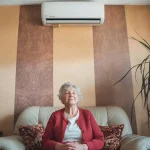
There’s a moment a lot of family caregivers describe to me, and it goes something like this: you walk into your parent’s house, the air conditioning is running, the thermostat reads 72 degrees, and yet your mom is sitting in her recliner with flushed cheeks, a wet forehead, and a glazed look in her eyes. You think, the AC is on, everything is fine. But everything is not fine.
I’ve been working in aging-in-place safety for years, and this is one of the most common and most dangerous misconceptions I see. A cool-reading thermostat does not mean a cool, safe body.
For older adults, the gap between those two things can be significant, and in extreme heat, it can be life-threatening. The good news is that once you understand what’s actually happening, you can do something real about it.
Air conditioning alone is often not enough to protect an older adult from heat-related illness, because aging significantly reduces the body’s ability to sense and respond to rising temperatures, and factors like high indoor humidity, certain medications, and cognitive impairment can make heat far more dangerous even in a seemingly cool room. The most effective cooling strategies for seniors combine humidity control, targeted body-cooling techniques, consistent hydration with electrolytes, and close observation, especially for anyone living with dementia, who may not feel or report being overheated.
Why Aging Rewires the Body’s Response to Heat
To understand why air conditioning isn’t always enough, you first need to understand what happens inside an aging body when temperatures climb.
In a younger, healthy person, the thermoregulation system works like a well-tuned engine.
Core temperature rises slightly, the hypothalamus signals the sweat glands to activate, sweat evaporates from the skin, and the body cools down. Blood vessels near the skin dilate to release heat. The whole process happens quickly and efficiently.
By the time someone reaches their 70s and 80s, nearly every part of that system has slowed down. The number of functional sweat glands decreases with age, and the ones that remain respond more slowly.
Reduced circulation means less blood flow to the skin surface, which limits heat transfer. Thinner skin and decreased subcutaneous fat provide less insulation but also less temperature buffering. And the hypothalamus itself becomes less sensitive, which means the signal to start cooling often fires late.
Older adults also lose their sense of thirst before they become clinically dehydrated, which means they may not drink enough to support sweating, even when their body desperately needs that cooling mechanism.
This is not a matter of willpower or paying attention. It is a physiological change that happens gradually and is completely invisible from the outside. Your parent is not being dramatic when they say they’re hot despite the thermostat reading 72. Their body is telling them the truth.
The Medication Factor That Changes Everything
One of the first things I look at when a family comes to me worried about a loved one’s heat tolerance is the medication list.
This is an area where clinical background matters enormously, because the interactions between common medications and heat stress are not widely understood outside of medical and occupational therapy settings.
Several categories of medications commonly prescribed to older adults directly interfere with the body’s ability to cool itself. Diuretics, often prescribed for blood pressure or heart failure, increase fluid loss through urine, which depletes the fluid reserves needed for sweating. Beta-blockers slow the heart rate, which limits blood flow to the skin and reduces heat dissipation.
Anticholinergic medications (including some bladder medications, certain antidepressants, and many antihistamines) actually suppress sweat gland function directly. And antihistamines, including over-the-counter allergy medications your parent may be taking on their own, can significantly reduce sweating and raise core temperature risk.
The problem is layered. Many older adults are taking several of these medications at once. And because thirst perception is already dulled by age, a person on a diuretic who also takes an antihistamine for allergies may be in real trouble on a hot humid day, even indoors.
I’m not suggesting you change your loved one’s medications. That is a conversation for their physician, and it’s one worth having before summer peaks.
What I am suggesting is that you treat any senior on these medications as higher-risk and build extra precautions into your summer care routine accordingly.
Humidity Is Doing More Damage Than the Temperature
Here is where I see the most misunderstanding, even among well-meaning caregivers. People focus on air temperature and ignore humidity, and that can be a genuinely dangerous mistake.
The body’s primary cooling mechanism is evaporation. Sweat forms on the skin and evaporates into the surrounding air, taking heat with it. That process only works if the surrounding air has room to absorb more moisture.
When humidity is high, the air is already saturated, and sweat cannot evaporate efficiently. The body’s cooling system stalls.
When indoor humidity climbs above 60 percent, even a room held at 72 to 74 degrees Fahrenheit can feel oppressive and can interfere with an older adult’s ability to regulate body temperature.
This is why a senior can be sitting in an air-conditioned room and still be overheating. If the AC unit is undersized for the space, if it has not been maintained, or if the humidity is not being drawn out of the air effectively, the temperature reading on the wall means very little.
The fix here is practical. Aim to keep indoor relative humidity between 40 and 55 percent during summer months.
A basic digital hygrometer (a device that measures humidity) costs under $15 and gives you a much more accurate picture of the indoor environment than the thermostat alone.
If humidity is consistently high, a dehumidifier used alongside the AC can make a meaningful difference in how the room actually feels and functions for an older body.
You can find more on safe indoor temperature ranges in this guide to safe home temperatures for seniors, which covers both heat and cold thresholds.
Fans — When They Help and When They Make Things Worse
Fans are one of the most misunderstood tools in summer safety for seniors, and the answer is genuinely more complicated than most people realize.
A fan works by increasing airflow across the skin, which speeds up sweat evaporation and makes the body feel cooler.
When the ambient air temperature is below about 95 degrees Fahrenheit and humidity is not extreme, fans are genuinely helpful. They support the evaporative cooling process and can reduce perceived temperature meaningfully.
When the air temperature rises above roughly 95 degrees Fahrenheit, or when humidity is very high, a fan stops cooling and starts to work against the body. At that point, blowing hot, humid air across the skin does not increase evaporation. It acts more like a convection oven, moving warm air across a surface that is already struggling to release heat.
In a home with functional air conditioning maintaining temperatures in the low-to-mid 70s, a fan can be a useful supplement, helping circulate the cool air and prevent pockets of trapped warmth.
The most effective placement is a floor or table fan positioned to create cross-ventilation, pulling cooler air across the body rather than simply oscillating back and forth.
One specific use I recommend often is a small desk or clip fan directed toward the neck and face during meals or seated rest periods.
The neck is a pulse-point area with major blood vessels close to the surface, and gentle airflow there can help the body feel measurably cooler without much effort.
What Actually Cools a Senior’s Body Down
Once you understand the mechanisms above, the practical strategies become clearer. Here is what actually works, and why.
Cooling From the Outside In
The fastest way to help an overheated senior is to apply cool (not cold) water to high-blood-flow areas of the body.
The wrists, inner forearms, neck, temples, and backs of the knees are all places where blood vessels sit close to the skin. A damp cloth or cooling towel applied to these areas cools the circulating blood directly.
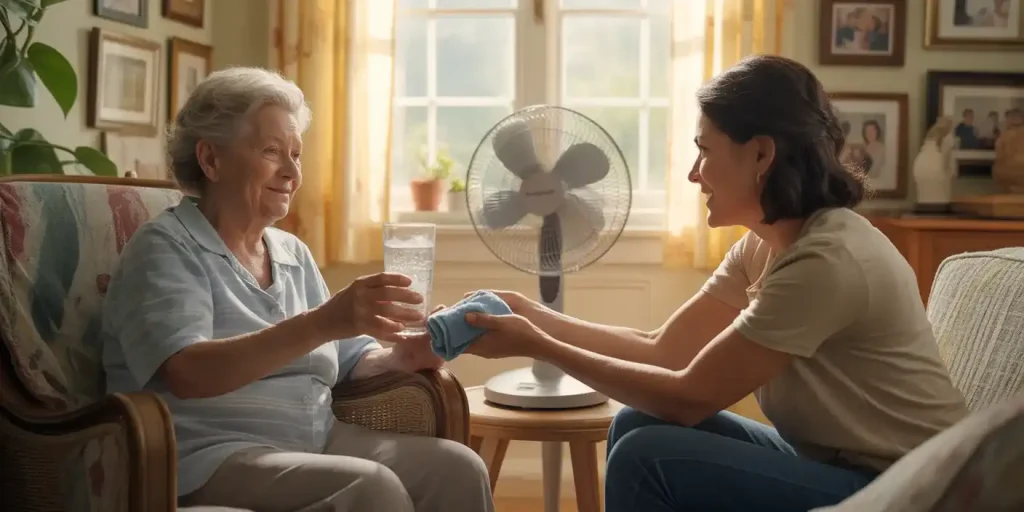
Cooling towels (the kind you dampen and snap to activate) work well for this and are easy to use. I recommend keeping two or three in the refrigerator during summer months so they are ready when you need them.
For seniors who will tolerate it, a cool damp cloth placed on the forehead and another on the back of the neck during rest is one of the most effective non-medical interventions I know.
A cool foot soak is another underused strategy. Sitting with feet in a basin of cool water for 15 to 20 minutes can reduce core temperature noticeably and is generally well-tolerated even by seniors with balance concerns (supervised, of course).
Cooling From the Inside Out
Hydration is not optional during summer, and for seniors, it requires active management rather than passive hope. Because the thirst signal is unreliable, you cannot count on your loved one asking for water when they need it.
Offering fluids on a schedule, every 60 to 90 minutes during the day, is a more reliable approach.
Plain water is helpful, but during periods of heat stress or heavy sweating, electrolyte balance matters too. Sodium, potassium, and magnesium are lost through sweat, and replacing only fluid without replacing electrolytes can lead to a condition called hyponatremia (low sodium), which causes confusion, headache, and in severe cases, seizures.
For most healthy seniors, foods like bananas, watermelon, broth, or a small amount of a low-sugar electrolyte drink can address this without any special intervention.
This guide on how to encourage seniors to drink more water has helpful practical approaches if fluid intake is a persistent challenge, and this article on hydration tools for elderly adults covers cups, bottles, and reminder strategies that make a real difference in daily intake.
Managing the Room Itself
Beyond the thermostat and humidity, a few room-specific strategies make a meaningful difference.
Closing blinds and curtains on east-facing windows in the morning and west-facing windows in the afternoon blocks solar heat gain before it enters the room. This single step can reduce indoor temperature by several degrees in a sunny home.
Light-colored, loose, breathable clothing made from natural fibers like cotton or bamboo allows sweat to evaporate more freely than synthetic materials. If your loved one is still wearing their usual sweater or heavy robe out of habit, a gentle conversation about summer clothing can be genuinely protective.
If Your Loved One Has Dementia, Read This Section Carefully
This is the part of heat safety that most general articles skip over, and it is the part I feel most compelled to cover clearly because the stakes are so high.
People living with Alzheimer’s disease or other forms of dementia often have impaired temperature perception.
The same neurological changes that affect memory and judgment can also affect the brain’s ability to interpret signals from the body, including signals that say “I am too hot.” A person with moderate to advanced dementia may be dangerously overheated and feel, or report, nothing unusual at all.
This means that asking your loved one “Are you hot?” is not a reliable safety check. You need to watch for behavioral and physical signs instead. Increased agitation or restlessness with no clear cause can be a sign of heat discomfort.
So can sudden increased confusion, withdrawal, or a change in gait. Flushed or dry skin, a faster pulse, and any change in breathing pattern are all physical cues worth acting on.
In a person with dementia, behavioral change during a heat wave should be treated as a possible heat-related symptom until proven otherwise.
In my clinical experience, many of the “difficult behaviors” families notice during hot weather are actually the body’s only way of communicating heat distress when words are no longer reliable. Trust the behavior, not the verbal report.
Warning Signs That Require Immediate Action
Even with the best precautions, heat illness can happen. Knowing the difference between heat exhaustion and heat stroke matters because one requires a call to the doctor and the other requires a call to 911.
Heat exhaustion presents with heavy sweating, cool and pale skin, a fast but weak pulse, nausea, muscle cramps, tiredness, and weakness. The person may feel faint or dizzy. Move them to a cool area, apply cool damp cloths, offer fluids if they are alert and able to swallow, and call their physician.
Heat stroke is a medical emergency. Signs include a body temperature above 103 degrees Fahrenheit, hot and red skin (which may be dry or damp), a rapid and strong pulse, and confusion, altered speech, or loss of consciousness.
Call 911 immediately. While waiting for help, move the person to a cooler location and apply ice packs or cold wet cloths to the armpits, neck, and groin. Do not give fluids to someone who is confused or unconscious.
For broader context on summer risks and early warning signs, the summer safety tips for seniors article covers additional outdoor and indoor heat precautions that complement what is covered here.
Conclusion
If you take one thing from everything I have written here, I want it to be this: the thermostat reading is not the whole story.
A cool-seeming house can still be a dangerous environment for an older adult if humidity is high, if key medications are on board, if fluids are not being replaced, or if the person living there has lost the ability to accurately feel and report their own discomfort.
That is not a reason to panic. It is a reason to pay closer attention and take a few targeted, practical steps. Check the humidity. Keep the fluids coming on a schedule.
Know which medications your loved one takes and what they do. Have a cooling towel in the refrigerator. Watch behavior, not just the thermostat.
Summer safety for seniors is not complicated once you know what you’re looking for. And now you do.