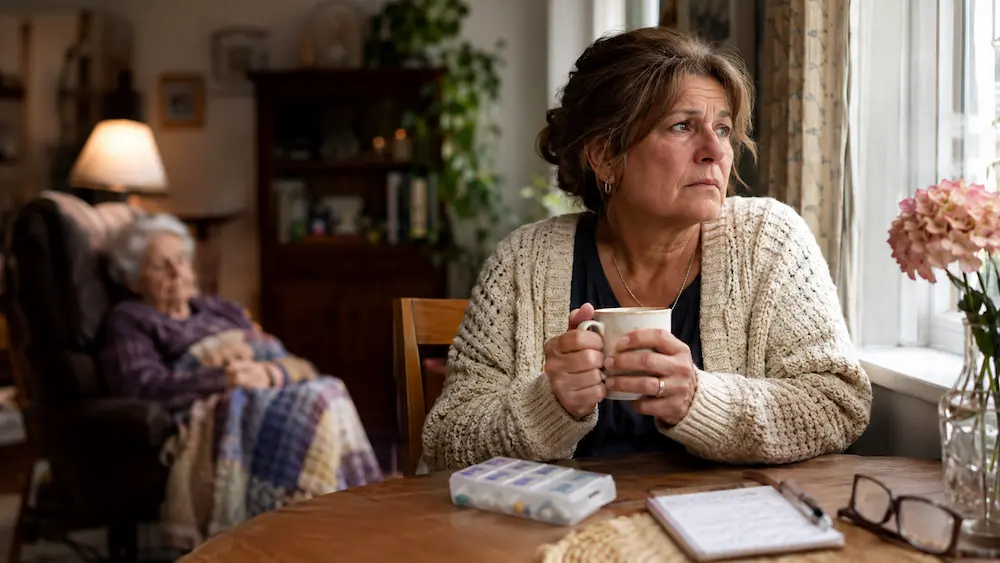
The day went fine. Your mom ate dinner, took her pills, and went to bed without a fuss. Nothing is wrong. So why are you lying awake at 2 a.m. with your heart thumping, running through everything that could go wrong tomorrow?
I worked for many years as an occupational therapist with older adults and their families. I heard some version of this story from caregivers again and again. Most of them shrugged it off with the same four words: “I’m just stressed out.” Some of them were right. Many of them were not.
Stress is a reaction to something specific, like a hospital stay or a stack of bills, and it eases when that pressure lifts. Anxiety is worry that stays with you even on the calm days, often with no clear cause, and it starts to change how you live. If your worry does not fade when the problem is handled, you are likely dealing with anxiety, and that is worth a conversation with your doctor.
Why Stress and Anxiety Feel Like the Same Thing
Your body does not send two different signals. Stress and anxiety both show up as poor sleep, tight shoulders, a short temper, foggy thinking, and deep tiredness. The American Psychological Association notes that the two produce almost the same set of symptoms.
So you cannot tell them apart by how you feel in the moment. A pounding heart is a pounding heart.
This is why so many caregivers get it wrong. Your friends tell you that you are stressed. Your siblings tell you that you are stressed. You tell yourself the same thing, because caregiving is hard and stress makes sense.
I have written before about how caregiver stress affects your mind and body, and all of it is real. But stress is not always the whole story.
Most People Don’t Know What Anxiety Feels Like
Here is something I wish more people understood.
Most people with anxiety do not think, “I feel anxious.” They think, “I can’t sleep,” “My stomach is always in knots,” or “I just can’t relax.”
Anxiety rarely announces itself. It does not always look like panic or shaking hands. More often it feels like:
- A constant sense that something bad is about to happen
- A mind that will not shut off at night
- A body that is always braced, as if waiting for a phone call
- Snapping at people over small things
- Feeling tired and wired at the same time
Many caregivers I worked with had lived this way for so long that it felt normal. They thought this was just what being a responsible person felt like.
Then there is the second problem. Some people do suspect it is anxiety, and they do not want to say so. I understand that. Many of us were raised to believe that anxiety means you are weak, dramatic, or not coping.
“Stressed” sounds like a busy person. “Anxious” sounds like a person who is falling apart.
That belief is wrong, and it keeps good people from getting help. Anxiety is a health condition, the same as high blood pressure. It is not a flaw in your character, and it says nothing about how strong you are.
The One Question That Separates Them
When a caregiver asked me how to tell the difference, I gave them one question to answer honestly:
“If the hard thing went away tomorrow, would this feeling go with it?”
Stress points at something. You can name it. Dad fell last week. The insurance company denied the claim. Your brother has not called in a month. When that thing gets handled, your body settles down.
Anxiety does not need a reason. It floats, and it attaches itself to whatever is nearby. You solve one worry and another takes its place within the hour. The National Institute of Mental Health puts it this way: anxiety can happen even when no threat is present.
Here is how that looks in real caregiving life:
- Stress: You are tense all week before your mother’s surgery. She comes through it well, and that night you sleep for nine hours.
- Anxiety: The surgery goes well. That night you lie awake worrying about infection, then about her stairs, then about your own health, then about nothing you can name.
Why Caregiving Blurs the Line
There is a catch, and you may have spotted it already. In caregiving, the hard thing never fully goes away. There is always another appointment, another change, another decision. So how can you run the test?
You look at the quiet moments. Think about:
- The day your sister took over and you had a full afternoon to yourself
- The hours after you got good news from the doctor
- A morning when everything on your list was done
Did your body let go, even a little? Or did the dread follow you to the coffee shop?
I watched this pattern many times. A caregiver goes months or years without a real break. The stress never gets a chance to switch off. Over time, worry stops being a reaction and becomes the setting their body runs on.
Long-term stress that never lets up can turn into anxiety, which is why caregivers are at higher risk than most people.
What Anxiety Looks Like in a Caregiver’s Day
The “What If” Loop
You rehearse disasters that have not happened.
- What if she falls while I’m at work?
- What if I miss something?
- What if this is the start of the end?
You run the same loop again and again, and you never reach an answer.
Checking and Re-Checking
You check the stove twice, then drive back to check it again. You count the pills in the organizer you filled an hour ago. You call to make sure Dad picked up the phone, then call again that evening.
Pulling Back
You say no to lunch with a friend because something might happen while you are gone. You flinch when the phone rings. Your world gets smaller, one skipped outing at a time. This is also how caregiver loneliness takes root, and the two feed each other.
When Your Body Speaks First
Your stomach hurts most mornings. Your chest feels tight. You get headaches that no pill seems to touch. Sometimes the body reports anxiety long before the mind is willing to.
If You Are Asking About Your Parent or Spouse
Maybe you are reading this because of the person you care for. If so, know this: older adults almost never say, “I feel anxious.” They grew up in a time when you did not talk about such things.
My mother was born and grew up in Sicily. She lived through WWII, an abusive marriage, homelessness, hunger and poverty for most of her life. She suffered from severe anxiety, honestly, almost anyone would. Yet, she was convinced that anxiety was an “American” thing. We could not convince her otherwise. 🙂
Instead, she complained of stomach is upset. She refused outings to anywhere opting to just stay home. She needed to control every aspect of her life (and ours too!).
In my clinical work, the clearest example was fear of falling. A person falls once, and after that they stop walking to the mailbox. They grip the furniture. They move stiffly and take tiny steps.
The sad part is that this fearful way of moving makes another fall more likely. What looks like a balance problem is often anxiety underneath.
Other signs I learned to watch for:
- Refusing to be left alone, even for a short errand
- Calling you many times a day with small worries
- Giving up activities they used to love
- New trouble sleeping
Before you settle on anxiety, ask the doctor to look for other causes. A new medication, untreated pain, thyroid or heart problems, and early memory changes can all look like anxiety in an older adult. A good checkup comes first.
What Helps Stress, and What Anxiety Needs
This is why the right name matters. The two call for different kinds of help.
Stress gets better when you change the load. That means rest, a shared schedule with family, a problem that finally gets fixed, or a few hours of respite care each week. If cost is the barrier, there are respite grants for caregivers that can pay for that time off.
Anxiety needs more than a day off. If a full weekend away does not quiet your mind, more rest is not the answer. Anxiety responds well to treatment, which may include talk therapy, medication, or both. Your doctor is the right place to start.
Some daily habits help with both. A short walk, a steady bedtime, less caffeine, and regular time with people who care about you will all take the edge off. They are a good start. They are not a cure for anxiety that has settled in.
When to Call the Doctor, and What to Say
The National Institute of Mental Health lists three signs that stress may have become something more: your symptoms get in the way of everyday life, they cause you to avoid things, or they seem to be there all the time. If any of those fit, please make the call.
Caregivers often get brushed off with “Of course you’re stressed, look at everything you do.” So go in with clear words. You can say:
“For the past several weeks, I have felt worried most days, even when things are going well. It is affecting my sleep, and I have stopped doing things I used to enjoy. I would like to be checked for anxiety.”
That is specific and hard to dismiss.
A few things should not wait for an appointment. Call 911 for chest pain, trouble breathing, or fainting, because these can be signs of a heart problem. If you ever have thoughts of harming yourself, call or text 988 to reach the Suicide and Crisis Lifeline at any hour.
You Are Not Weak for Asking
I know how caregivers think. You put yourself last. You tell yourself you will deal with your own health when things calm down. But things may not calm down for a long time, and you matter right now.
Asking “Is this stress or anxiety?” is not a sign that you are failing. It is a sign that you are paying attention. Putting the right name on what you feel is an act of care, both for yourself and for the person who depends on you.
If it is stress, you now know that you need a lighter load, and you have every right to ask for one. If it is anxiety, you now know that it has a name and that it can be treated. You do not have to keep living braced for the next bad thing.
Whichever answer fits you, there is a way to feel better from here.