Every summer, I see the same story unfold. A senior ends up in the emergency room, confused, dizzy, and too weak to stand. Their family is stunned because nothing seemed seriously wrong. No fall. No chest pain. Just the summer heat doing its slow, quiet damage.
The cause? Dehydration.
And the hardest part to explain to worried families? Their loved one never once felt thirsty.
If you are an older adult, or if you care for one, this may be the most important summer health fact you will ever read: thirst is not a reliable warning system as you age. By the time you feel thirsty, your body is already working hard to catch up.
In my work as an Occupational Therapist and Certified Aging in Place Specialist, I call thirst a “lagging indicator”, it shows up late, and sometimes far too late.
This article will help you understand exactly why that happens, what signs to watch for before thirst ever arrives, and which simple daily habits can keep you or your loved one safe all summer long.
Why Aging Changes Your Thirst Signal
When you were younger, thirst worked like a well-timed alarm. You got warm or active, your body noticed the drop in fluid, and it sent you a clear signal to drink something. That system worked well.
But as you age, that alarm gets quieter. Research consistently shows that older adults have a reduced sense of thirst compared to younger people, even when they are just as dehydrated.
Here is why this happens.
Your brain has a small but powerful area called the hypothalamus. It monitors fluid levels in your body and triggers the feeling of thirst when levels drop too low. As you age, that sensing system becomes less sharp. It takes a bigger drop in fluid before it notices anything is wrong. (source: National Library of Medicine)
At the same time, your kidneys become less efficient at holding onto water. That means your body loses fluid more easily and cannot compensate the way it once could. And your body holds less total water than it did when you were younger. Older adults have a lower percentage of body water than younger adults do, so there is less of a buffer to begin with.
Medications add another layer of risk. Many common prescriptions, including diuretics (water pills), blood pressure medications, antidepressants, and antihistamines, increase fluid loss, reduce your body’s ability to conserve water, or dull your awareness of thirst. If you take any of these, your summer dehydration risk is meaningfully higher.
I want to say this clearly: none of this is your fault. This is simply how the body changes with age. But knowing it is your first line of defense.
Why Summer Heat Makes the Risk So Much Higher
Summer heat speeds up fluid loss in ways that many seniors do not expect.
When the temperature rises, your body sweats to cool itself down. But here is something important to understand: older adults sweat less efficiently than younger people. That might sound like a good thing, less mess, right? But it is actually dangerous.
Less sweating means your body struggles to cool itself properly. You can overheat faster than you realize, and your body is losing more fluid trying to do a job it cannot do as well as it used to.
What surprises many people is that you do not need to be outdoors for this to happen. I have worked with seniors who became seriously dehydrated inside their own homes on hot summer afternoons, with the windows closed and a weak fan doing little to help. Indoor heat is just as dangerous as outdoor heat.
High humidity makes things worse, too. When the air is already full of moisture, sweat cannot evaporate from your skin, so your body cannot cool down effectively. You keep losing fluid while your body keeps trying to compensate, and all of this happens without you feeling especially hot or uncomfortable.
You can lose a significant amount of fluid on a humid summer day without ever breaking a real sweat.
What Dehydration Looks Like Before You Feel Thirsty
This is the part of our conversation I care most about, because this is where I can genuinely help you stay safe.
Since thirst is a late signal, you need to know the earlier ones. Here are the signs I teach every senior client and family caregiver to watch for.
Check your urine color every morning. This is your most reliable daily tool, and it takes two seconds. Your urine should be pale yellow, think lemonade. If it looks more like apple juice or iced tea, your body is telling you it needs more fluid. Dark urine in the morning, consistently, is a clear sign you are not drinking enough throughout the day.
Watch for unusual fatigue. If you or your loved one seems more tired than usual, especially in the afternoon, mild dehydration may be why. Fluid loss affects your energy level long before it affects your thirst. This same fatigue also raises the risk of falls, something I take very seriously. You can learn more about the connection between low energy and fall risk in this article on fatigue and fall risk in seniors.
Pay attention to mental fog or sudden confusion. This one surprises families the most. Dehydration affects the brain faster and more severely in older adults than in younger people. If your loved one seems harder to reach in conversation, forgetful in a new way, or irritable without a clear reason, check their fluid intake before assuming something else is wrong. Confusion can come on quickly and look alarming, and it can resolve just as quickly with proper rehydration.
Notice dry mouth and dry skin. A sticky or dry mouth, cracked lips, or skin that does not spring back quickly when gently pinched at the back of the hand, these are signs your tissues are losing moisture. They often appear before any sense of thirst does.
Watch for leg cramps, especially at night. Muscle cramps that wake you up at night, particularly in the calves, can signal that your electrolyte levels are dropping due to fluid loss. Electrolytes like sodium, potassium, and magnesium work with water to keep your muscles functioning properly.
Pay attention to lightheadedness when you stand up. That dizzy feeling when you rise from a chair or get out of bed is called orthostatic hypotension. Low fluid volume is one of the most common causes. This kind of dizziness also dramatically raises your risk of a fall, so do not brush it off.
Notice changes in bowel habits. Your colon pulls water from digested food to do its job. When you are not drinking enough, stools get hard and dry, and constipation follows. Chronic constipation in an older adult is often a quiet sign that daily fluid intake is too low.
Who Is Most at Risk?
Some seniors face a higher chance of summer dehydration than others. You may be in this group if any of these apply:
You or your loved one has dementia or memory loss. People with cognitive changes often cannot recognize that they need a drink, or they cannot tell someone. They may refuse fluids without being able to explain why. For caregivers, this means building hydration into the daily routine, not waiting for a request that may never come.
You take diuretics, blood pressure medications, antidepressants, or antihistamines. These medications affect how your kidneys handle water and sodium, and some reduce your body’s awareness of thirst. If you take any of these, ask your doctor how they might affect your hydration needs in the summer months.
You have limited mobility. If getting to the kitchen or bathroom takes real effort, it is very common to unconsciously drink less, to avoid the trips. This is completely understandable, but it puts you at real risk. Solutions like keeping drinks within arm’s reach and using a bedside water bottle can help enormously.
You live alone. There is no one nearby to notice the early warning signs, remind you to drink, or step in when something seems off. A simple daily plan matters even more in this situation.
How Much Fluid Does a Senior Need Each Day?
A general starting point for most healthy older adults is about 8 cups, or 64 ounces, of fluid per day. But this is not a one-size-fits-all number. If you have kidney disease, heart failure, or another condition that affects how your body handles fluid, your doctor may recommend a different amount. Please always check with your physician before making big changes.
What counts toward your daily fluid total? Water is the best choice, but many other drinks and foods count too. Herbal teas, low-sodium broth, milk, and 100% juice all contribute.
Even coffee and regular tea, in moderate amounts, add to your total, though they do have a mild dehydrating effect, so they should not be your only source.
Food matters more than most people realize. Some foods have very high water content and contribute meaningfully to daily hydration.
- Watermelon
- Cucumbers
- Strawberries
- Oranges
- Celery
- Broth-based soups
- Plain yogurt
- Cottage cheese
Making these part of your regular summer meals is a smart and enjoyable way to boost hydration without tracking ounces.
Alcohol is a different story. It is dehydrating, and on a hot summer day, it speeds up fluid loss in a way that can become dangerous very quickly. On warm days, it is best to skip it or keep it to an absolute minimum.
Simple Strategies That Work Better Than Waiting to Feel Thirsty
Because you cannot rely on thirst to tell you when to drink, you need a plan that works on its own. Here are strategies I share with my own clients, practical, doable, and effective.
Drink on a schedule, not on demand. Build a simple routine into your day: one glass when you wake up, one with each meal, one mid-morning, and one mid-afternoon. That alone gets most seniors close to their daily goal without any guesswork or relying on their thirst.
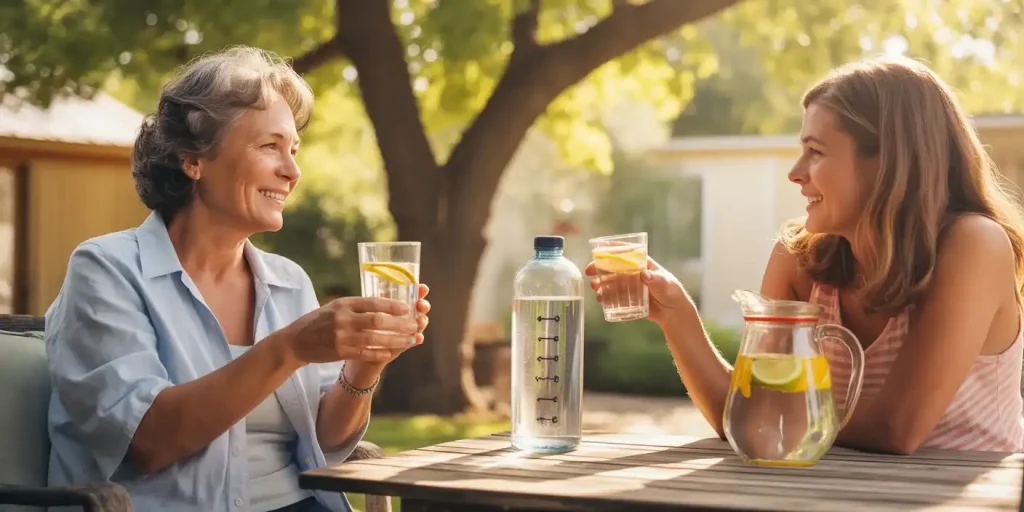
Use a marked water bottle for visual tracking. Seeing how much you have had, and how much is left, helps enormously. A water bottle with time markers or ounce markings gives you and your caregiver a clear, honest picture at a glance. There are also adaptive cups and bottles designed specifically for older adults with arthritis, tremors, or limited grip strength. You can explore a helpful range of hydration tools for elderly adults to find what fits your situation best.
Make water easy to reach. Keep a cup or bottle on your nightstand, one near your favorite chair, and one in the kitchen. If you use a walker or wheelchair, a cup holder attachment means your drink comes with you wherever you go. The less effort it takes to grab a drink, the more often you will actually do it.
Know when plain water is not enough. After sweating in summer heat, your body needs more than water, it needs electrolytes like sodium and potassium that plain water does not provide. Electrolyte drinks can help restore what you have lost. If you are trying to figure out which drink is best for your loved one, these two articles break it down clearly: Pedialyte vs. Gatorade for seniors and the best electrolyte drinks for seniors. Both are worth a read before you make a decision.
Use a smart speaker as a hydration reminder. Amazon Echo and similar devices can be set to remind you, or your loved one, to drink water at set intervals throughout the day. For seniors who live alone or who get absorbed in activities and lose track of time, this kind of gentle nudge works surprisingly well.
For caregivers supporting someone with dementia: build hydration into daily activities rather than asking. Offer a drink during activities the person already enjoys, while watching a favorite show, during a rest after a walk, or alongside a snack. Making it part of the moment removes the need for the person to initiate it themselves.
Something Worth Watching: Wearable Hydration Sensor
One development I want to flag for you, even though it is not quite available yet, is wearable hydration sensing technology. A company called WearOptimo is developing a small sensor worn on the skin that can detect mild dehydration continuously, without a blood draw or urine test.
Their early clinical data is genuinely impressive, in trials, it outperformed the standard blood-based dehydration test at catching the mild levels of dehydration that are hardest to identify. For older adults, who often have no obvious symptoms until dehydration is already moderate, that kind of early detection could be meaningful.
No consumer product is available yet, but this is the kind of technology worth knowing about. In the meantime, the morning urine color check remains your most reliable, no-cost, no-device tool, and it works right now.
When to Call a Doctor, Or Go to the Emergency Room
Mild dehydration, caught early, often responds well to drinking fluids at home. But moderate to severe dehydration needs medical care right away.
Do not wait and see if any of these appear:
- Extreme confusion or a sudden change in behavior or personality
- No urination for 8 or more hours
- A rapid or irregular heartbeat
- Sunken eyes or very dry skin that does not bounce back
- Fainting or loss of consciousness
- Inability to keep fluids down due to vomiting
If these signs appear, call 911 or go to the emergency room. Severe dehydration can become life-threatening very quickly in older adults, especially during summer heat. Please trust your instincts. If something feels seriously wrong, act on it.
A Word From Me to You
I know it can sometimes feel like there is always one more thing to worry about when it comes to staying safe as you age. I understand that. But this is one of those areas where a small amount of daily awareness can prevent a very large problem.
You do not need a complex system. You just need to stop waiting for thirst to tell you something is wrong, because it often will not. Check your urine color each morning. Drink on a schedule. Keep water close. Know the early signs. That is truly it.
You deserve to feel good and stay safe this summer. With a little planning and the right awareness, you absolutely can.