If you’re caring for someone with dementia you may have experienced the very frustrating moments when they become distressed and begin acting out.
This could look like screaming, banging, throwing things, etc.
Common Triggers That Can Cause Agitation In A Person With Dementia
Triggers of agitation and distress in individuals with dementia can vary widely, but some common causes include:
- Neurological and medical conditions: Such as delirium, stroke, or systemic inflammation.
- Psychiatric conditions: Including psychosis, schizophrenia, or bipolar disorder.
- Medication Interactions: Interactions between medications can lead to increased agitation.
- Environmental / Sensory Factors: Over stimulation from noise or activity, unfamiliar surroundings, or changes in routine can trigger distress.
- Emotional Stress: Feelings of loneliness, boredom, or frustration with the inability to perform simple tasks.
- Social factors: New caregivers, house guests, or loss of privacy and control.
- Changes in the environment: Such as low light or sunset, hospitalization, admission to nursing residencies, or changes in daily routines.
- Loss of Privacy or Control: Changes in living situations or caregiving arrangements that affect a person’s sense of privacy or autonomy.
- Physical Discomfort: Pain, hunger, thirst, or the need for toileting can lead to agitation if not addressed.
- Cognitive Challenges: Difficulty in understanding or communicating can be frustrating and lead to agitation.
(sources: alz.org and psychiatry.org)
Step-by-Step Guide: 12 Calming Techniques for Dementia Care
Here are 12 very helpful tips on the different ways that may help you and your senior loved one suffering from dementia or Alzheimer’s to get through these moments of agitation.
1. Keep Your Cool
I know that can be very difficult at times so if you find that you are beginning to lose your temper – it’s a good idea to take some deep breaths and do your best to redirect to another topic or task.
If possible, step away from the situation and help them to step away as well.
Talk to them in a positive manner. No matter what you do, it is important to remember to use a positive and calm voice when talking to your loved one.
Don’t use negative words or phrases or a loud voice. Instead, talk to them in a loving way and give them a little time to respond.
Of course, it’s difficult to do this on a constant basis so please make sure to get the respite care that you need to help you keep your stress levels down so that you can help your senior loved one.
2. Check To Make Sure They Are Not In Pain
You want to make sure that your senior loved ones angry outburst is not due to them being hurt or some kind of discomfort or some issue with health problems.
Maybe they are hungry or thirsty. Maybe their shoes are tight, their diaper is twisted, maybe the lighting in the room is too bright.
Fevers, arthritis pain or urinary tract infections would also create pain and discomfort.
Of course, if any of these issues are evident then seeking immediate medical attention is needed.
It could be any number of things or a combination of things that could be causing them some form of discomfort.
It may also just be that they are not able to express to you that they are not comfortable or in pain so they end up expressing it via agitation and anger.
Anxiety and agitation may be caused by a number of different medical conditions, medication interactions or by any circumstances that worsen the person’s ability to think. Ultimately, the person with dementia is biologically experiencing a profound loss of their ability to negotiate new information and stimulus. It is a direct result of the disease.
Alzheimer’s Association
3. Listen To Your Senior Loved One
If your loved one is able to verbally communicate with you – take some time to listen to what they are angry or frustrated about.
Here are some tips on how to actively listen:
- Pay one-on-one attention to your senior loved one.
- Make eye to eye contact with him/her.
- Avoid asking open-ended questions.
- Be patient and give them time to respond to you.
- Do not patronize or ridicule them in any way. You may think you are making a joke but they may not be able to comprehend the nuances of your humor.
- Acknowledge what they are saying by casually rephrasing their statement and responding to it.
- If they can tolerate physical touch put your hand on them which can show them that you are paying attention just to them.
Make sure to listen carefully to what your loved one is saying. This will allow you to determine what their needs are.
Remember that they are often confused and may be having a hard time understanding words.
Don’t push your own agenda. Just concentrate on what THEY are saying.
If they aren’t able to verbally communicate and are just ranting nonsensical words or sounds then work on comforting them by any of the following techniques:
- Keep your body language calm and receptive to them by facing them, direct eye to eye contact and placing your hand on them (if they can tolerate it).
- Try your best to show a pleasant and happy look on your face.
- Keep your tone positive and friendly.
- Approach your loved one from the front.
- For some seniors with dementia, personal space is an issue so respect that.
4. Watch Their Reactions
In addition to listening to them, you also want to watch how they react to certain situations and stimulations.
- Observing their reactions can provide invaluable insights into what comforts or distresses them.
- Pay close attention to their facial expressions, body language, and verbal cues. For example, a furrowed brow, clenched fists, or a sudden change in posture might indicate discomfort or agitation, while a smile, relaxed shoulders, or a calm demeanor could suggest contentment and ease.
By understanding and responding to these non-verbal signals, caregivers can significantly enhance the quality of life for individuals with dementia, fostering a supportive and understanding environment.
If they are not able to verbalize their pain, try to read their facial expressions. At the same time, do you best to communicate with them with YOUR facial expression.
If you appear worried or afraid, that may make the situation worse.
5. Physical Activity
Sometimes the best thing to do to relive stress and anxiety is some type of physical exercise. It’s a great way of relieving stress and anxiety which can help greatly to help calm down someone with dementia.
Give your loved one the opportunity for some type of physical activity, like walking around a mall or going on walks in their neighborhood with you!
One valuable source discussing the impact of physical activity on behavior in dementia patients is provided by National Library of Medicine.
Their document highlights that physical exercise is crucial for maintaining good blood flow to the brain, which may encourage new brain cell growth and survival.
This suggests that regular physical activity can have significant benefits for individuals with dementia, potentially influencing behavior positively by improving cognitive function and reducing the risk of further cognitive decline.
6. Quiet Down The Environment
It’s much easier to calm someone down when there isn’t a lot of noise around. At least a lot of loud noise.
For some, soft, melodic sounds can be used as music therapy to help calm them down.
For many of us, being in a noisy environment can be stressful – so you can only imagine how much more stressful that can be for someone with dementia or Alzheimer’s.
Of all the senses, hearing is the one that has the most significant impact on people with dementia in terms of quality of life. This is because dementia can worsen the effects of sensory changes by altering how the person perceives external stimuli, such as noise and light. As hearing is linked to balance this also leads to a greater risk of falls either through loss of balance or through an increase in disorientation as a result of people trying to orientate themselves in an environment that is overstimulating and noisy.
Social Care Institute For Excellence
So keeping the environment as “pleasant” as possible for your senior loved one may actually help to decrease the number of outbursts that he/she may be experiencing!
Don’t forget that lighting is a sensory stimulation as well. But this can be tricky because older adults need more light to see as well as they did when they were younger.
Yet, if the lights are too bright – that may cause them some discomfort. You will have to play with the lights to see what works best for your loved one.
7. Use Positive Sensory Stimulation
In addition to music, as I mentioned above, there are other sensory stimulations that can play a significant role in calming down someone with dementia.
These include the following:
- Food: which can evoke pleasant memories or feelings of comfort.
- Textures: which can provide a soothing tactile experience through items such as soft blankets, plush toys, or various craft materials
- Scents: which have the power to relax the mind, trigger positive memories, and significantly reduce agitation
A study published in the National Center for Biotechnology Information (NCBI) discusses the benefits of sensory and memory stimulation therapies for individuals with dementia.
The authors conclude that these therapies have the potential to improve many dementia-specific issues, including agitation and overall well-being.
8. Stick To A Routine
According to the Alzheimer’s Project, the importance of routine and familiarity for persons with dementia cannot be overstated.
Daily structure can help decrease undesired behaviors by providing a predictable and familiar environment, which in turn, can enhance the individual’s sense of security and well-being.
Sudden changes in daily routines, such as taking a vacation, can bring about anxiety and fears and cause someone with dementia to lash out.
A good way of incorporating routines into people’s lives is through setting up daily activities like chores, shopping trips with friends (or family), and taking medications at set times each day.
Anything you can do consistently on an everyday basis so they know what comes next in their day!
9. Clean Up The Environment
Along with a noisy surroundings you also want to simplify and declutter the surroundings as well.
I’ve spoken quite a bit about decluttering and the benefits of that for all seniors – but for the ones who are living with dementia – it holds significant importance.
The reason that a decluttered environment is more important for seniors with dementia is because of the effects that this disease seems to have on someone’s perception.
Meaning that their ability to distinguish one object or color from another may become distorted.
What makes decluttering a home of someone with dementia a bit more difficult is that hoarding is a fairly common symptom of dementia.
Persons with dementia experience memory loss, mental confusion, disorientation, impaired judgment and behavioral changes. One of these changes may include “hoarding”. While hoarding is often harmless, it can become a health and safety issue for the person with dementia.
Alzheimer’s Association
10. Redirect To Another Topic
When I worked in nursing homes I often worked with patients with dementia and they would sometimes become agitated.
One trick that I used that usually worked well was to redirect my patient to a new topic and sometimes even to move them to a different room.
If I knew them and knew of a topic or task that they enjoyed then I would redirect them to that.
Here are some tips on how to use the Redirection Technique:
- Don’t dismiss their feelings. If they are talking that they have to get to the doctor’s appointment (when you know there isn’t one) the thing to NOT do is to keep telling them that there isn’t an appointment. Instead, talk about what needs to be done at the appointment which is later. Ask them questions about what do they need from the doctor? How do they expect the doctor to help them?
- Change the environment. If you can go into another room to work on a project or if you can go outside for a walk – that sometimes helps to get their mind off whatever they may be obsessing and becoming agitated about.
- Present a new meaningful activity. It’s sometimes helpful to redirect your loved one to a meaningful activity. You could say something like, “Mom, I need these towels folded, can you do that for me please?”
…just like anyone else, people with dementia need meaningful activities to fill their days. The family is in the best position to help them find purpose in their day, even through small things.
aarp.org
11. Enter Their World
Try to engage in conversation with whatever thoughts they are expressing.
If they are talking about going to the prom with someone then talk to them about being at a prom, dancing and about high school, etc.
The most important issue caregivers need to understand is seniors with dementia are experiencing their own realities. In order to appease a senior’s agitation and aggression, caregivers need to tap into this reality and embrace it.
fivestarseniorliving.com
If they begin talking about a deceased loved one as if they are still alive – don’t remind them that the person has died.
Instead ask them about their memories of that person, be specific if you can.
An example could be, “Dad, what kinds of games did you and uncle Mark play when you were kids?”
Try to keep conversations at a level where they will be able to understand them. By doing so, you are also helping them to relax.
This will in turn help them function better once they begin to remember things. This is especially true if you have been assisting them with a difficult task for quite some time.
Sometimes – getting busy with a simple and fun activity may be helpful.
12. Be Careful With Touch
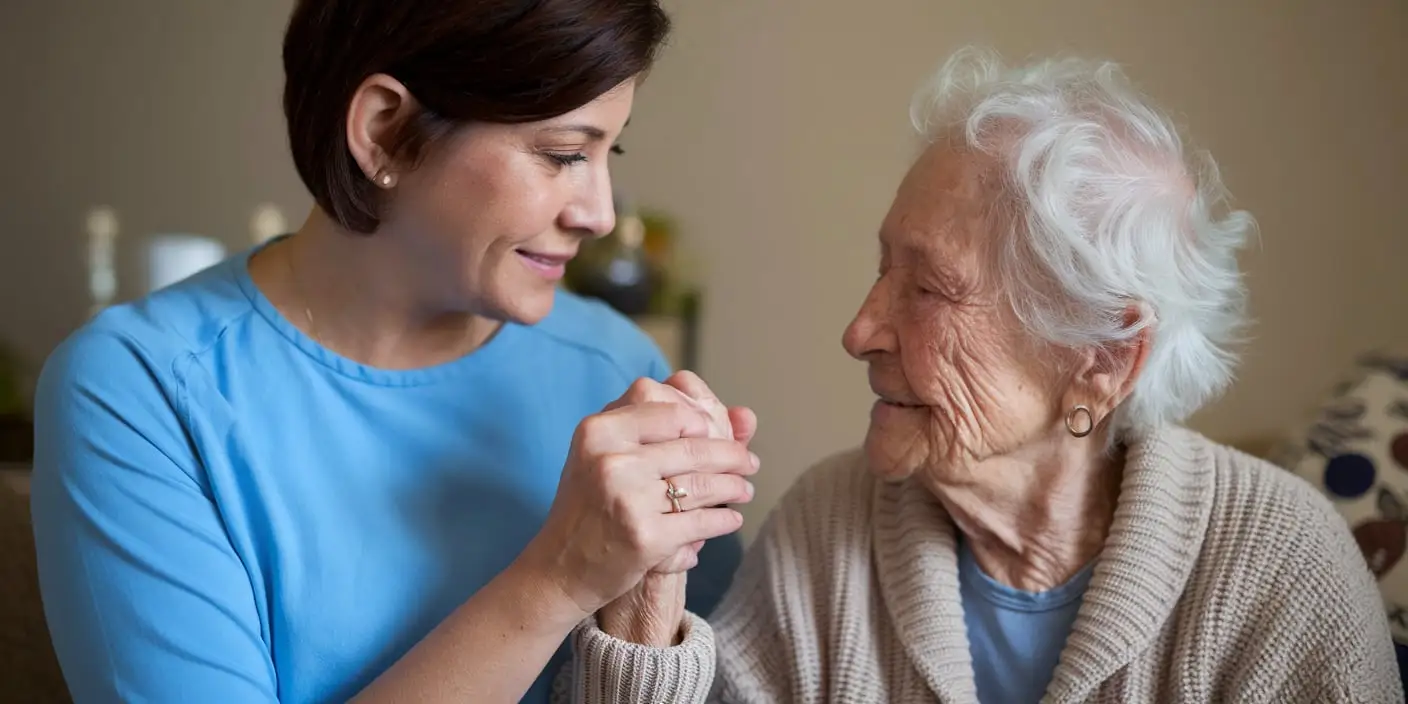
Some seniors with dementia can be calmed down with a gentle touch. A hug or simply hand holding. (source: National Library of Medicine)
But others with dementia may not like being touched at all. So, please be aware of what your loved one can tolerate.
Some types of massage can help to calm someone down and improve overall mental and physical health.
The key is to find the right one for the particular needs of the person you are trying to help.
13. Pet Therapy
Don’t discount the many great benefits that pet therapy can do to help calm down someone suffering from dementia or Alzheimer’s disease.
Even a stuffed animal like these robotic cats and dogs have been very useful in helping to calm down patients with issues related to cognitive decline.
There is substantial research supporting the notion that activities involving pets (and in some cases stuffed animals) can be beneficial to people living with Alzheimer’s. These activities usually reach those in the latest stages of the disease—even when they no longer talk or recognize loved ones.
usagainstalzheimers.org
Read about how to take away a pet from a dementia patient if they can no longer care for them.
14. Don’t Be Shy – Ask For Help
Finally, don’t be afraid to ask for assistance. That means getting some respite care. It may be helpful to ask for help at various stages of your caregiving journey.
This could be something that a professional such as a therapist or even your doctor can help you with.
There are also many online support groups that you can look into for help.
The bottom line is that while you need to know how to help someone with dementia, you do not have to do it alone.
The longer you wait to do something, the harder it will be.
When Medical Attention Is Needed
When caring for an elderly parent with dementia, it’s crucial to recognize when their agitation or distress signals a need for medical attention.
Here are several situations when seeking medical help is advisable:
- Sudden Change in Behavior: If you notice a rapid or significant change in your parent’s behavior that cannot be calmed with usual interventions, it might indicate an underlying medical issue or a severe progression of dementia.
- Signs of Pain or Discomfort: If you suspect that their agitation is due to pain or physical discomfort that you cannot identify or manage, professional evaluation is necessary. Pain can stem from various sources, such as infections, dental issues, or chronic conditions that require medical treatment.
- Aggressive Behavior: If your parent becomes aggressive, posing a risk to themselves or others, and you cannot safely manage the situation, it’s important to seek help. Aggression can be a sign of fear, confusion, or frustration, but it requires professional assessment to determine the cause and appropriate interventions.
- Severe Anxiety or Panic: When symptoms of anxiety or panic are intense and do not subside with comforting measures or routine interventions, medical advice can help identify the cause and provide treatment options.
- Health Deterioration: Any signs of rapid health deterioration, such as significant weight loss, refusal to eat or drink, or persistent sleep disturbances, warrant medical attention. These could indicate medical conditions that need immediate treatment.
- Ineffectiveness of Medications: If your parent is on medication for dementia or related symptoms and you observe no improvement or worsening conditions, a healthcare provider should reassess the medication regimen.
In any of these situations, it’s important to contact your parent’s healthcare provider for advice.
In cases of severe distress or emergency, don’t hesitate to seek urgent care or call emergency services.