Browse All Workbooks & Checklists
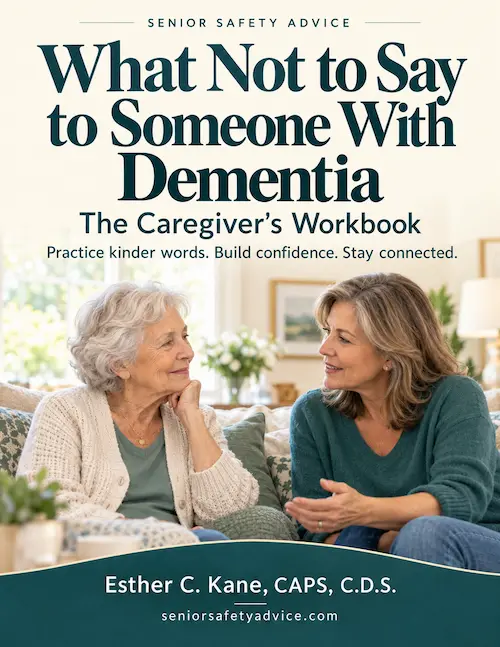
Words matter more than we realize when talking with someone who has dementia. This printable workbook helps family caregivers replace hurtful phrases with calm, respectful ones through practice exercises, realistic scenarios, and planning pages.
Inside the workbook, readers will find:
- Know Your Loved One: a profile page for the favorite music, memories, and topics that help you connect and redirect
- My Phrase Audit: a look at ten common phrases to avoid, with space to note what happened and what you’ll say instead
- Why These Words Hurt: a short exercise to understand how certain phrases affect your loved one and your relationship
- Rewrite It: practice turning confusing or upsetting statements into short, clear, kind ones, plus validate-and-redirect pairs
- “What Would You Do If…” Scenarios: ten real-life situations, such as “I want to go home,” questions about a loved one who has died, and accusations of stealing, with room to write your response
- Repeated Questions Tracker: a weekly log and ten tips for staying patient
- Body Language and Touch: a self-check and a place to record your loved one’s signals
- Room Walk-Through: a worksheet for lighting, noise, distractions, and visual cues
- Planning for Each Stage: communication strategies for early, middle, and late-stage dementia
- Caregiver Frustration and Self-Care: warning signs, a trigger log, a calm-down plan, and a support team list
- Visitor and Family Cheat Sheet: a cut-out page of do’s and don’ts to share with relatives and friends
- My 30-Day Plan: three small changes to practice, with weekly check-ins and reflection
- Resources and Next Steps: types of help to contact, and an action checklist
- Notes Page: space for phrases that work and questions for the doctor
30 pages, printable in black and white. Pairs with the companion checklist.
Secure checkout powered by Stripe.
You’ll see our parent company, Couch Cats, LLC on your statement!
Sample Preview
Important Disclaimer: This workbook is for educational purposes only and is not medical, legal, or professional advice. It is not a substitute for the guidance of your loved one’s doctor, a licensed healthcare provider, or a dementia care specialist. Dementia affects every person differently, and the communication strategies in this workbook may not work the same way for everyone. Always talk with a healthcare professional about changes in memory, behavior, mood, or safety. If you believe your loved one is in immediate danger or having a medical emergency, call 911 or your local emergency number right away.