| Quick Answer Yes, origami is an excellent craft for older adults. It gently exercises fine motor skills and hand-eye coordination, stimulates memory and focus, and provides a meaningful sense of accomplishment. It requires no special equipment, can be done seated, and adapts easily to different ability levels, making it one of the most accessible and brain-healthy hobbies for seniors. |
My aunt Ruth is 79 years old. After her husband passed, she told me she felt like her hands had forgotten what to do with themselves. She was restless, a little foggy, and struggling to fill the quiet hours.
Her daughter brought home a beginner’s origami book on a whim. Within a week, Ruth had made twelve paper cranes and given them as gifts to everyone on her street.
What happened for Ruth is not unusual. Crafts that seem simple on the surface often deliver something profound: purpose, focus, and a quiet kind of joy. Origami, in particular, has qualities that make it especially well-suited for older adults, and I want to share exactly what those are.
If you are a senior looking for a new hobby, or a caregiver wondering what to try with a loved one, keep reading. I think you will find something genuinely useful here.
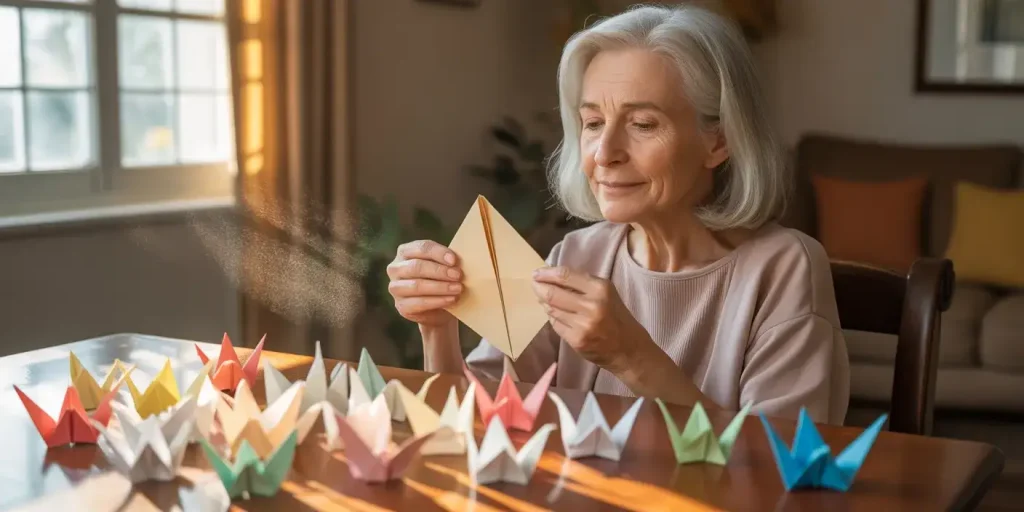
Is Origami a Good Craft for Older Adults?
Yes, origami is one of the best crafts I recommend for older adults, and here is why: it is low-cost, low-risk, and high-reward. You do not need to stand at a table, lift anything heavy, or buy expensive supplies. A single sheet of paper and a flat surface are all it takes to get started.
Origami is also scalable. A beginner can learn to fold a simple boat or flower in minutes, while someone with more experience can work on intricate geometric designs that take hours of focused attention. That range is important, it means origami grows with you and stays interesting over time.
For older adults who feel limited by mobility issues or chronic pain, origami offers a seated, gentle activity that still delivers real mental and physical engagement.
Why Origami Is Especially Beneficial for Seniors
The benefits of origami go far beyond keeping your hands busy. Research has shown that activities requiring precise hand movements and sequential thinking help maintain cognitive sharpness as we age.
Here is what origami specifically supports:
- Fine motor skills: Folding paper requires careful finger movements that exercise the small muscles of the hands and fingers.
- Hand-eye coordination: Lining up folds and matching corners precisely keeps your visual and motor systems working together.
- Memory and concentration: Following a sequence of steps, and remembering where you left off, engages working memory and sustained attention.
- Spatial reasoning: Visualizing how a flat sheet becomes a three-dimensional object is a genuine cognitive workout.
- Mood and stress relief: The repetitive, focused nature of folding has a calming effect similar to meditation for many people.
- Sense of accomplishment: Completing a project, no matter how small, produces real feelings of pride and capability.
These are not small things. For an older adult navigating the emotional and physical changes that come with aging, activities that support all of these areas at once are genuinely valuable.
Signs That Origami Might Be the Right Fit
Not every craft suits every person. Here are some signs that origami could be a great match for your loved one or for yourself:
- You enjoy puzzles, patterns, or anything that involves following steps.
- You want an activity you can do alone without needing a class or group.
- You have mild hand stiffness but still have reasonable grip and dexterity.
- You are looking for something meaningful to do with your hands while watching television or sitting quietly.
- You want a hobby that produces something you can share or give as a gift.
- You are searching for a low-cost activity that does not require a car trip or internet access.
Origami is particularly well-suited for adults who tend to be self-directed and detail-oriented. If you have ever enjoyed sewing, woodworking, model-building, or crossword puzzles, there is a good chance origami will feel satisfying in a similar way.
What to Do to Get Started With Origami
Getting started is easier than most people expect. Here is what I recommend if you or a loved one wants to try origami for the first time.
Start with the simplest possible project. A flat bookmark or a basic paper cup is a good place to begin. Success in the first session matters, it builds the confidence to keep going. Avoid jumping straight to complex animals or geometric designs that require many steps.
Use the right paper. Origami paper is thin, square, and creases cleanly. You can find it at craft stores or online for just a few dollars. For beginners with hand stiffness, slightly heavier paper or even regular printer paper can work and is easier to control.
Follow visual instructions. Video tutorials on YouTube are especially helpful because you can pause and rewatch each step. Search for “easy origami for beginners” and you will find dozens of gentle, step-by-step guides. Books with large, clear diagrams also work beautifully.
Work at a table with good lighting. Proper lighting reduces eye strain and helps you see fold lines clearly. Good posture at a table also protects your back and neck during longer sessions.
Fold with a friend or family member when possible. The social element adds joy and makes it easier to stay motivated. Caregivers who sit and fold alongside a senior often find it becomes a cherished routine.
| I once read a powerful story on Origami Spirit about a man named Ronald who suffered a stroke that left one side of his body paralyzed. At first, he believed the life he loved was over, especially his passion for origami. But something simple changed everything. While in the hospital, he picked up a piece of paper and slowly began folding with his non-dominant hand. What started as a small, hesitant attempt turned into hours of practice each day, giving him purpose, focus, and a reason to keep trying. As he continued folding, something deeper happened. Origami helped him shift from feeling defeated to feeling determined. It kept his mind engaged during long hospital days and gave him a sense of accomplishment with each completed piece. Even more meaningful, he began sharing his creations with nurses, therapists, and other patients, turning a quiet activity into a way to connect with others. This story is a beautiful reminder of why I often recommend simple hand-based activities like origami for older adults. It supports fine motor skills, encourages problem-solving, and provides emotional comfort during difficult times. In my experience as an occupational therapist, I’ve seen how something as simple as folding paper can restore confidence, bring joy, and help someone feel like themselves again, one small fold at a time. |
Tools, Supplies, and Resources for Senior Origami
You do not need much to get started, but a few thoughtful choices can make the experience more comfortable and enjoyable.
- Origami paper packs: Available at craft stores like Michaels or online through Amazon. Look for packs with larger sheets (6×6 inches or bigger) for easier handling.
- Large-print origami books: Titles like “Easy Origami” by John Montroll use clear diagrams and are well-suited for older eyes.
- YouTube channels: “Origami with Jo Nakashima” and “Sara Adams” offer hundreds of free video tutorials ranging from beginner to advanced.
- Origami.me website: Is a simple, easy-to-use website that offers step-by-step origami instructions, diagrams, and beginner-friendly guides that make paper folding accessible and enjoyable for people of all ages.
- Folding boards: A small scoring board helps create crisp, even folds, especially useful for those with hand weakness.
- Magnifying glass or reading glasses: For detailed fold lines, good magnification makes a real difference.
- Daylight LED lamp: Proper lighting reduces eye strain and makes fold lines much easier to see.
Many senior centers and public libraries also offer free origami workshops or craft groups, which add a social dimension to the hobby. It is worth calling your local senior center to ask what is available.
When to Adapt Origami or Consider Alternatives
Origami is not right for every older adult, and it is important to be honest about that. There are situations where adaptations or alternatives make more sense.
If a senior has significant hand tremors, severe arthritis, or limited grip strength, standard origami paper may be too frustrating. In those cases, try larger sheets of thicker paper, pre-folded crease templates, or craft foam sheets, which are more forgiving and easier to handle.
For adults living with moderate to advanced dementia, complex multi-step origami may cause confusion or distress. A better approach is to involve them in simple, repetitive folding tasks, like folding napkins or making flat shapes, which can still be calming and meaningful without requiring sequenced memory.
If someone has vision difficulties that make following fold lines difficult even with magnification, consider pairing origami with a hands-on guide who folds alongside them, or switch to a texture-based craft like weaving or clay that does not rely as heavily on visual precision.
The goal is always engagement and enjoyment. If origami in its standard form is not working, it is worth experimenting with adaptations before giving up on it entirely.
The Bottom Line
Aunt Ruth still makes paper cranes. She gives them to nurses, neighbors, and grandchildren. She told me recently that folding gives her something to look forward to each morning, a small act that makes her feel capable, creative, and connected.
That is what a good hobby does. It does not have to be dramatic or ambitious. It just has to be meaningful.
If you are an older adult looking for something to do with your hands and your mind, or a caregiver searching for an activity that will genuinely engage your loved one, I encourage you to give origami a try. Start simple. Be patient. And let the process be the point.
Even a single folded crane carries something real inside it, attention, care, and the quiet satisfaction of making something with your own hands.
Frequently Asked Questions
| Question | Answer |
| Is origami good for dementia patients? | Simple, repetitive folding tasks can be calming and engaging for people with mild to moderate dementia. Complex multi-step designs may cause frustration, so it is best to start with very easy folds and provide hands-on guidance. The sensory and tactile experience is often more important than completing a finished product. |
| What is the easiest origami for seniors with arthritis? | Larger sheets of paper (8×8 inches or bigger) and slightly heavier paper stock are easier to handle for adults with arthritis. Simple flat designs like bookmarks, envelopes, or basic boats require fewer tight folds and less finger precision than three-dimensional animals or geometric shapes. |
| Does origami improve memory in older adults? | Origami engages working memory, spatial reasoning, and sequential thinking, all cognitive functions that benefit from regular exercise. While it is not a medical treatment for memory loss, activities like origami are recommended by occupational therapists as part of a broader strategy for maintaining cognitive sharpness in aging adults. |